


Sunday, March 29, 2009

"Television Infomercials" poll

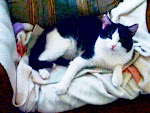
A rare photo of the Oxford and Bruno preparing their stick in selling highly concentrated Acapulco catnip for "purrfect" mental "cattentment" on the Cat Channel...all for $19.95 plus $4.95 for shipping and handling. [The product is actually dried grass clippings spiked with old Hartz Mountain catnip. FTC is investigating.]

Television Infomercials...do you watch, believe, and buy?

Yes...0
No...2
Sometimes...0

Snake oil salesmen [and saleswomen] are everywhere on television. They are obnoxious, loud, manipulating, and even hide under the PBS logo. They sell goods and services that are appealing--must have goodies...they will make life easier, make us smarter--all for $19.95. But for the most part they are self-serving entrepreneurs taking advantage of the viewers and lining their pockets with greenbacks. Complaints range from delayed shipments, defective goods, and terrible customer service. I have seen a few--all for entertainment. My favorite was the hype of the Barack Obama commemorative $1 coin sets. Enameled portrait of President-elect Obama was applied to perfectly good $1 coins now to be bought as historical collectibles to be squirreled away with the basic anticipation that they will be valuable in the future. Guess what...they will be worth $1 each. I know things are economically tough with PBS affiliates but hours and hours during pledge weeks of the likes of Wayne Dyer, Suzie Orman, and Daniel Amen are insulting and not representative of PBS.

"PBS's latest infomercial"

By airing another self-help show disguised as medical science -- the dubious "UltraMind Solution" -- the public network continues to undermine its credibility.

by

Robert Burton

March 12th, 2009

salon.com

In May I reported that PBS stations were airing medical programs that weren't adequately reviewed or vetted by either the local station or parent PBS corporation. My concern was that publicly funded stations were broadcasting questionable medical claims, made by Daniel Amen, M.D., about unproven methods for the prevention and treatment of Alzheimer's disease, without properly warning viewers the information was controversial. I suggested that, at the very least, the stations should present a clearly visible banner or disclaimer that the program doesn’t represent the views of the local station or PBS. Even a self-serving commercial station like CNBC informs viewers of each talking head's personal involvement with any stock being discussed, and infomercials are clearly labeled as "Paid Programming."

Unfortunately, nearly a year has passed and nothing has changed. Last week, I turned to my local PBS station, KQED, and ran headlong into yet another program of medical self-promotion. Mark Hyman, M.D., a family physician, was talking about "brain fog" and "broken minds" and how such "conditions" could be cured or prevented by using "The UltraMind Solution" -- a combination of books, DVDs and home questionnaires.

Before I could change the channel, I heard Dr. Hyman make the following comments: "The way we think about disease, mental illness, and our brain aging, actually has nothing, nothing to do with how our body actually works … The way we think about disease is all wrong … the name of the disease tells us nothing about the real reason or the causes of them. Diseases don't exist."

Surely this rather unconventional opinion should have caught the attention of those responsible for airing this program on public television. I find it hard to believe that this type of rhetoric can be seen as consistent with mainstream medical wisdom, even by those who are not well versed in science.

If Dr. Hyman is correct, then we should disregard present medical knowledge and research. And yet, to justify his pet theories, Dr. Hyman cherry-picks from the very medical literature that he thinks approaches disease from the wrong perspective. Take, for example, his opinion that "the most remarkable scientific finding of the last decade is that you can have an inflamed, sore and swollen brain." And from his blog site: "New research proves that almost all brain problems are connected to or caused by inflammation." Indeed, Dr. Hyman opines that "if you treat the inflammation, the symptoms go away."

To support this fringe opinion, Dr. Hyman has used what I refer to as a cut-and-paste technique; he takes isolated observations out of context to generate a theory not proven or justified by the findings.

He begins by saying that Martha Herbert, M.D., neurologist at Harvard, "has found that kids with autism have swollen large brains on MRI." But what Dr. Herbert has written on the National Autism Association Web site is that "children with autism tend to have heads that are larger than normal," but when "you look at the brains of these children with large heads using an MRI scan, they usually look normal." Her conclusion: "At the current time, we do not understand the relationship of the large brains to the autism in these children."

Note to Dr. Hyman: Larger is a measurement of size and isn't synonymous with swollen.

Equally puzzling is his line of reasoning in assigning inflammation a primary role in diseases as diverse as autism and Alzheimer's. Dr. Hyman cites the observation of Johns Hopkins neuroscientist Dr. Diana Vargas that there is evidence for "inflammation in the spinal fluid and brains of autistic children." But in her paper, Dr. Vargas points out that "there has been no direct evidence linking findings in the peripheral blood to immune activity in the brain of autistic patients; the most comprehensive postmortem study reported no inflammatory changes or glial reactions." (Glial cells are the non-neuronal brain cells that, among other things, protect against pathogens and remove the debris of neurons that have died.) However, with new techniques, Dr. Vargas believes that she has demonstrated glial reactions in the brains of autism sufferers.

Finding such glial cell changes, if confirmed in other laboratories, wouldn't be particularly surprising. Glial cells respond to all sorts of insults. Dr. Vargas has found similar findings in widely disparate disorders, including Alzheimer's disease, Parkinson's disease and amyotrophic lateral sclerosis -- all diseases for which the underlying causes remain poorly understood, but are associated with destruction of neurons specific to that illness. Perhaps the glial reactions seen by Dr. Vargas are nothing more than a normal response to damaged or dead neurons.

An appropriate analogy would be a bacterial sore throat. The streptococcus organism causes the sore throat; what we see on examination of the throat is inflammation of the underlying tissues. But it wouldn't make sense to say that the inflammation caused strep throat; rather it would be a response to the strep. In order to blame inflammation as the primary cause, one has to abandon the traditional disease model -- the position that Dr. Hyman takes at the start of his program.

Note to Dr. Hyman: Association is not causation.

There is no need for a further line-by-line dissection of Dr. Hyman's claims. His opinions are clearly controversial both in terms of content and logic, and it doesn't take a medical degree to spot them. Nor does it take more than a few minutes on the Internet to uncover the discrepancies between Dr. Hyman's comments and the actual research cited.

My first exposure to public television was in 1955, watching "Science in Action," a program locally produced by the California Academy of Sciences. Through the years, I have felt that PBS has provided many of the best science programs on television. Science is a method of thought. It's through good science programs that we learn how to think, including how to properly assess conflicting information. I would hate to see their airtime curtailed because of lack of funding.

But showing dubious science like Dr. Hyman's "The UltraMind Solution" on pledge nights, as KQED has been doing in past weeks, is to demean viewers' reasons for watching public television. Apparently PBS's mission is to raise money by exploiting viewers' gullibility at the expense of trustworthy programming. If so, it has achieved its goal -- and undermined the central reason for having educational TV in the first place.


Efficient appliance or just aesthetics or fraud

Repair your scratch?...Billy Mays can--NOT

Saturday, March 28, 2009

"NASA in 10 years" poll


Will NASA still be a leading figure in space science in 10 years?

Yes...2

No...2

A draw. Certainly one cannot make an accurate prediction but consider the educational status of the United States, less money being funded for science education, strong restrictions on foreigners to enter this country, long term economic crisis, more players in the field of space science and one can doubt NASA's position in a decade.

Galileo's telescope in Philadelphia

Not much to see but it is Galileo's telescope.

What a fantastic opportunity to see Galileo's actual telescope.

"A Telescope to the Past as Galileo Visits U.S."

by

Dennis Overbye

March 28th, 2009

The New York Times

PHILADELPHIA — It looked like the kind of toy telescope a child might have made with scissors and tape — a lumpy, mottled tube about as long as a golf club and barely wider in girth, the color of 400-year-old cardboard, burning with age.

But near one knobby end was a bit of writing that sent Derrick Pitts, chief astronomer of the Franklin Institute here, into rapture. The tube's focal length is "piedi 3," the inscription said, three feet. It was in the hand of Galileo Galilei. "Absolutely amazing," Dr. Pitts said.

Thus did Galileo, one of history's great troublemakers, come to America.

By turning spyglasses like this to the sky 400 years ago and seeing mountains on the Moon and satellites whirling around Jupiter in contravention of the Earth-centered cosmology of Aristotle, Ptolemy and the Bible that had reigned for a thousand years, Galileo changed the world.

His discoveries propelled astronomers on a course toward discovering signs of the Big Bang and a shadowy modern cosmos suffused with dark energy and dark matter. And his tangle with the church became the template for the war between science and religion that persists to this day.

Only two of the dozens of telescopes Galileo built survive. Neither have ever been out of Florence since Galileo's time. That is, until this week, when Giorgio Strano, curator at the Institute and Museum of the History of Science there, escorted this humble tube to the Franklin Institute.

Scholars do not know when Galileo built this particular telescope, or what he saw with it, but it still has its original optics. A brief audience with the telescope — under the stern gaze of Dr. Strano — gives you an idea of how hard it must have been for Galileo to be Galileo.

Squinting through the eyepiece as the tube lay on a table, hands gloved but careful not to actually touch the telescope, I found the field of view strikingly narrow. Down a tunnel of blackness all the light of the room was compressed into a blurry, fragile dot.

In order to accomplish high magnification on the planets, Galileo had to settle for seeing a very small slice of sky — about half the diameter of a full Moon in the case of this telescope — making it correspondingly difficult to find anything in the sky. Mapping the Moon, for example, would require moving the telescope.

Galileo began to build telescopes, gradually increasing in magnification, in the fall of 1609 after hearing that a Dutch spectacles maker, Hans Lipperhey, had built a spyglass. He probably made his first observations, of the Moon, in October, said Owen Gingerich, a historian of astronomy at Harvard.

At the same time, Thomas Harriot in England was observing and mapping the Moon, but failed to publish anything.

But Galileo, knowing he had ammunition to upend the universe, rushed into print in March 1610 with his report, Sidereus Nuncius, "Starry Messenger."

He sent a copy of the book, along with the telescope he had been using, to the Grand Duke of Tuscany Cosimo II de' Medici. Dr. Gingerich said the pamphlet amounted to "a job application" to the Medici family for whom, in one of history's first examples of branding, Galileo named the four satellites of Jupiter.

"Other planets were gods or goddesses," said Paolo Galluzzi, director of the Florence institute. "The only humans with position in sky were Medicis."

The ploy worked, Cosimo II hired Galileo as his astronomer, elevating him from a poorly paid professor at the University of Padua to a celebrity, making the equivalent of $300,000, a year, Dr. Galluzzi said. Galileo returned the favor by giving Cosimo another telescope, clad in red leather and stamped with decorations.

Galileo's social skills deserted him when it came to the church, even though he claimed to be a good Catholic. In 1633, after having been enjoined 17 years before from promoting the Copernican theory, Galileo was summoned to a trial in Rome, convicted of holding views "contrary to Scripture" and declared "vehemently suspect of heresy."

Galileo recanted and spent the rest of his life under house arrest, the enduring symbol of persecution of science by the church. He died in 1642, probably outliving many of his telescopes.

Of the first telescope Galileo sent to Cosimo II, with which he said he discovered the satellites of Jupiter, all that remain are the pieces of the main lens, which was dropped and broken in 1635, Dr. Galluzzi said. Cosimo's red leather telescope is intact but has only one of its original lenses.

The telescope now in Philadelphia is made of two half-cylinders of wood wrapped with varnished paper and held together by rings of wire. Dr. Galluzzi called it "a working tool," one Galileo could have kept and used his whole life, but nobody knows for sure.

The Florence institute that is home to both remaining telescopes is undergoing renovations this year, so it seemed an opportune moment to let at least one Galileo instrument go on a road show. (The leather one remains in Florence.) The wooden spyglass will be the centerpiece of "Galileo, the Medici and the Age of Astronomy," which opens April 4 at the Franklin Institute. The show, which runs until September, is part of the International Year of Astronomy, celebrating 400 years of modern astronomy.

The show will then travel to Stockholm in time for the Nobel Prize announcements in October before returning to the Florence institute, which will reopen as the Galileo Museum, Institute for the History of Science.

Dr. Strano, guardian of the telescope, allowed its visitors to spend only a little time with it before locking it up. Seeking more of the Galilean experience, Dr. Pitts and I went to the Franklin's roof with a replica of Galileo's red telescope. Made in Florence 60 or 70 years ago, the replica was itself an antique and had to be handled with white gloves.

Hoisting the long tube to our eyes like pirates or whalers on the lookout for Moby Dick, Dr. Pitts and I traded off, focusing the telescope by sliding the eyepiece in and out while staring at the illuminated tops of Philadelphia skyscrapers.

Then we went looking for stars, but there were only clouds. Finally a bright star, which Dr. Pitts identified as Sirius, appeared through a hole in the clouds to the southeast. Hoisting the telescope, weaving slightly, I scanned the sky trying to bring it into view.

Galileo, of course, had some kind of mount that told him exactly what direction he was pointed. I had Dr. Pitts standing behind me. "Up, up," he said, "to the left, left, left, too far, back to the right, up up. You should have it."

But that star never swam into my sights, and after half an hour my arms and shoulders were aching from keeping the telescope aloft. Clouds reclaimed Sirius.

It’s not easy being Galileo.

By the way Tim, check out...

Galileoscopes


Deceased--Charles Dahanayake

Charles Dahanayake
February 8th, 1928 to February 14th, 2009

"The scientific community has lost a bright star"

Professor Charles Dahanayake

by

R.O.B. Wijesekera

March 22nd, 2009

The Sunday Times

Wijeya Newspapers Ltd.

It is the custom in the Sri Lanka Association for the Advancement of Science (SLAAS), to commit a group of past-general presidents to select the oncoming general president. As some of us gathered this year for this task, we noticed an empty chair.

Said ex-general presidents Priyani Soysa and Swarna Jayaweera in unison to me, "Our Charles is sadly no more". Charles, a regular member of the panel usually occupied that chair, and the absence of the short man with the long silver hair was keenly felt.

I came to know of Charles's demise only when I returned from a month's holiday in Australia. He was well when I left, and I frequently troubled him with complaints regarding the school which occupied my former neighbours' bungalow and which showed scant respect for neighbours. Charles happened to be one of the directors of the school. He listened to my complaints in his usually dignified and courteous manner and promised to relay my feelings to the authorities. So I was understandably sad and felt the same way as colleagues Priyani and Swarna. We are all now in the category of "octogenarians". So we are an endangered species. It is not a surprise when one of our number is called away. But since we have known each other for so long it is hard to take too. This time it was worse for the manner in which Charles succumbed to a tragic accident was in contrast to the placid manner of the man.

I first came to know Charles in 1947 when we were both new entrants to the University of Ceylon. Charles entered with a scholarship in Physics. He did a special degree in Physics during the tenure of Professor. A.W. Mailvaganam as the Head. In those days there was only one professor, and "Myla" as he was affectionately known, was Physics itself for the University students. He was feared as Dean, and admired for the clear, lucid lectures he delivered without even a piece of paper in his hand. Charles matured in the Department of Physics in this milieu, which then included such high calibre individuals like V. Appapillai, Themi Mutucumarana, Lakshman Kannangara, Osmund Jayaratna and the inimitable and amiable Indian S.P. Baliga. In time, and this was 1951, Charles as expected netted a first class honours degree, and with it the scholarship to proceed to the U.K. for his Ph.D. Charles was also promptly appointed an assistant lecturer in Physics.

As was the tradition at the time, Charles too like his mentor Myla took to research on Cosmic Rays and was accepted in 1954, to research at the prestigious school in Bristol University headed by the Nobel laureate C.F. Powell FRS. It was indeed a privilege that Charles had gained by his own academic excellence, and his association with Mylvaganam, whose work on cosmic rays was one of the initial research initiatives at the then university.

It was my pleasure to keep in close touch with Charles and when I too went to England the following year for my own Ph.D. Charles came to London to welcome me. I was in Sheffield and although we were far apart, we met regularly in London at the then Ceylon Students Centre. Charles was a devotee of the London temple then headed by the Rev. Sadhatissa Thera. He was always a devout Buddhist and a most disciplined individual.

I recall asking Charles at the time what indeed was the importance of cosmic rays, and he as usual explained clearly to me what they were.

Coming from space and incident on the high atmosphere are a relatively thin layer of charged particles which are called cosmic rays. At the time there were two important reasons for studying them. These particles moved more than a million times faster than any particles delivered by the laboratory accelerators. Collisions with other particles produced effects that were fundamental to knowledge about the structure of matter.

Secondly the presence of these particles presented a cosmological problem as to from where they came. During this time there were no space explorations, and this kind of research was the forerunner to the space programmes we know of today.

So Charles was very much then at the frontiers of the exciting problems in fundamental particle physics.

He was well thought of as a researcher and that was saying alot.

In 1957, Charles and I together with my cousin Chandi Wijesekera then doing accountancy also at Bristol, ventured on our first trip to the continent. We had meagre resources, but we managed to go to France, Germany, Switzerland, Denmark and Italy with our savings. We enjoyed the trip immensely. In Germany a Bristol colleague of Charles, Klaus Pincau, a German student also working with Powell, together with his fiancee arranged for us to lodge in a Hostel of the University of Hamburg. Klaus's fiancée Ursula, a charming girl was a student there; and the German authorities allowed us, as British University students good accommodation in their hostel in the charming village of Blankanese. We who were brought up in the colonial days to believe how cruel the Germans were, these were days after the war - were pleasantly surprised to find the contrary was true.

Soon Charles completed his Ph.D., and returned to Sri Lanka. The atmosphere in Sri Lanka in the year after his return virtually put paid to any research ambitions he may have nursed. Firstly, Physics is a fundamental subject; research in this area has to be endowed with investment in state-of-the-art equipment. In any event Universities at the time were saddled with the emotional thrust for teaching in the national languages, and the necessary priorities of nursing tertiary education, fell by the wayside.

This was the time I too had returned to Sri Lanka. It was a difficult time for research with support not forthcoming. We met together with other U.K.-returned contemporaries and literally "tired the sun with talking and sent him down the sky."

Our respective entries into family life took us in different directions but I kept company with Charles in the scientific communities' affairs.

Charles played a leading role in enhancing the language in terms of education in Physics, and he was proficient to lecture in his subjects though the handicaps with the language were great. There was no systematic scientific terminology and all of it had to be coined and drafted. Charles also continued with his active support of the SLAAS, and was elected President of the Physical Sciences section in 1974, and finally elevated to general president in 1990. His interest in the organization was sustained till the end as was his interest in the teaching of Physics. He was the Head of Physics, at the Kelaniya University for more than two decades and laid the foundation for science education there with the late Professor J.K.P. Ariyaratne.

His presence will be sorely missed within the scientific community as well as his exemplary manner and ethics of conduct. Charles was above all a family man and to his wife and children go our heartfelt sympathies. They have lost a dear family head and the scientific community one of its most respected members.

May Nibbana be his just reward

"Remembering Professor C. Dahanayake"

by

Professor K.D. Jayasuriya

[Department of Physics, Faculty of Science, University of Kelaniya]

March 28th, 2009

Daily News

Sri Lanka

Emeritus Professor Charles Dahanayake, the Founder Professor of Physics and Founder Dean of Science of the University of Kelaniya passed away on February 14, 2009 at the age of 81. The following is a note of appreciation.

I first met him 30 years ago, when I joined the Department of Physics of the Kelaniya University as an Assistant Lecturer (Probationary) in Physics. Ever since, I have also known him as a special, kind hearted unassuming person.

He was a gentleman in every sense of the word, always ready to be of assistance with excellent advice to all who seek it from him. He was always simple and ready to look at anything in an unbiased way. His simplicity was shown in his dress, expenditure, lifestyle and basically in everything that he did. He was a good, silent observer who could fit into any occasion. Never did he speak of his achievements and if it had been done, I am sure it was solely for the benefit of the younger generations. He was liked by both his colleagues and everyone in the Faculty of Science, Kelaniya University, who all think highly of him.

Early education

Prof. Dahanayake was born on February 8, 1928 at Hiyare in the hinterland of Galle. He had his early education in the village school. After completing his first certificate examination, then known as the Junior School Certificate (JSC) in Swabhasha, he moved to Vidyaloka Vidyalaya in Galle and sat the JSC in the English medium in 1944. To study science, he entered to the Senior Form at Ananda College in Colombo in 1945. During the next two years he surprised everyone by passing the Senior School Certificate (SSC) with Arts subjects, the SSC with Science subjects, London Matriculation and the University Entrance Examinations and being awarded the entrance Mathematics scholarship.

Prof. Dahanayake entered the University of Ceylon in 1947 to follow the B.Sc. Special Degree course in Mathematics. He won the Muncherji Framji Khan Prize at the end of his first year at the University and got permission to complete the B.Sc. Special Degree in three years. By that time he was fond of Physics and to the disappointment of the Professor of Mathematics, he moved to the Physics Department to follow the B.Sc. Special Degree course in Physics. He graduated with a First Class (Honours) in Physics in 1951.

Prof. Dahanayake started his long and successful career in Physics by joining the Physics Department of the University of Ceylon, Colombo in 1951 as an Assistant Lecturer. He moved to the United Kingdom in 1953 on a Ceylon University Government Scholarship to pursue his postgraduate studies at the University of Bristol. At Bristol, he carried out his research work on Cosmic Rays under the supervision of Prof. C.F. Powell, FRS and Noble Laureate, and obtained his Ph.D. degree in the field of High Energy Particle Physics, in April 1956.

Doctoral degree

Prof. Dahanayake returned to the University of Ceylon, Colombo soon after obtaining the doctoral degree and continued his teaching and research work. He was promoted to the Lecturer Grade II in 1956 and to the Lecturer Grade I in 1961.

During his sabbatical leave period in 1962, he went to the University of Rochester, USA on a Fulbright Post-Doctoral Research Fellowship to carry out research on Primary Cosmic Rays.

During July 1963 to September 1967, he worked at the University of Ceylon, Peradeniya as a Senior Lecturer and continued his research work on Fundamental Particles.

Prof. Dahanayake came to the Vidyalankara University (presently the University of Kelaniya) in September 1967 as the first Professor of Physics and the first Head of Physics in its newly established Faculty of Science.

He was also the first Dean of Science, a post which he held for seven years, of the University of Kelaniya. One of his major contributions to the University of Kelaniya, and in particular to the Faculty of Science was the effort he put in as the Dean in getting the Faculty on to a sound footing.

Prof. Dahanayake nursed the faculty from its infancy to maturity and we all in the Faculty of Science are grateful to him for his contribution.

Prof. Dahanayake was a pioneer of Science in Swabhasha. He wrote a book titled Prayogika Bhawthika Vidyawa (Practical Physics) in Sinhalese. This book has become a widely used Physics book by Sinhala medium G.C.E. (A/L) students and first year Physics students of the universities.

He has also translated the book by J.K. Robertson titled "Optics - Geometrical and Physical" into Sinhalese and was also a member of the Physics Glossary Committee of the Educational Publications Department.

Physics journal

He was the Chief Editor of Vidura, a Science Magazine in Sinhala and the Chief Editor of Sri Lanka journal of Physics published by the Institute of Physics, Sri Lanka (IPSL). He was the Controlling Chief Examiner in Physics from 1971 to 1974 and the Moderator of the Physics paper from 1986 to 1990 at the G.C.E. (A/L) Examination. He was a member of the Committee to review the G.C.E. (A/L) Physics syllabus of the National Institute of Education from 1898 to 1991.

The Institute of Physics, Sri Lanka (IPSL) was one of the institutions he helped to establish and he was the Founder President of it. He was a life member and a Fellow of the IPSL and was a member of the IPSL Council from its inception to his demise. He was a life member of the Sri Lanka Association for the Advancement of Science (SLAAS) and was the President of its Section E in 1974 and then the General President of SLAAS in 1990. He was a Fellow of the National Academy of Science, Sri Lanka (FNASSL) from its inception. He was a Board member of the Atomic Energy Authority (AEA) and also of the Sri Lanka Standards Institute (SLSI). He was also a member of the Sri Lanka Association for Science and Mathematics Education (SLASME).

Kelaniya University

Prof. Dahanayake retired from the University of Kelaniya on July 31, 1993. He then continued as the Professor of Physics on contract basis till April 1996. He had the distinction of having served 45 years in Sri Lankan Universities, of which 29 years was at the Kelaniya University.

After considering the contributions he made in the fields of Physics and Education and also to the development of the Kelaniya University, Prof. Dahanayake was appointed as an Emeritus Professor in the Physics Department, Kelaniya University in January 1997.

During his retirement he continued to participate in many academic activities of the University of Kelaniya, IPSL and SLAAS and gave his advice and ideas to all who sought them from him. His keen intellect, wise guidance and gentle humour will be deeply missed.

University of Kelaniya

Friday, March 27, 2009

"Moon exploration" poll


There is talk of returning to the moon. Do you think it is based on...

Pure science...1
Economics...0
Political...0
All of the above...3

For the one that voted "Pure science", I would ask how all the science would be funded and wouldn't a position on the moon be somewhat strategic--politics?

"Across The Universe"

Across The Universe

Has anyone seen Julie Taymor's Across The Universe and care to share thoughts?

Across The Universe

2007

Julie Taymor


"Lovers in the ’60s Take a Magical Mystery Tour"

by

Stephen Holden

September 14th, 2007

The New York Times

From its first moments, when a solitary dreamer on a beach turns to the camera and sings, unaccompanied, the opening lines of the Beatles' song "Girl," Julie Taymor's '60s musical fantasia, "Across the Universe," reveals its intention to use the Beatles' catalog to tell two stories at once, one personal, the other generational. That young man, Jude (Jim Sturgess), is a cheeky Liverpool dockworker with a twinkle in his eye. He quickly emerges as a winsome vocal composite of John Lennon and Paul McCartney, with a personality to match.

From here the movie only gets better. Somewhere around its midpoint, "Across the Universe" captured my heart, and I realized that falling in love with a movie is like falling in love with another person. Imperfections, however glaring, become endearing quirks once you’ve tumbled.

That surrender is the kind of commitment that Ms. Taymor, a true believer in the magic of art, asks of an audience. And as the movie intensifies, and she brings in a fantastic array of puppets, masks and synergistic effects, you may find yourself in a heightened emotional state, even as you realize that what you’re seeing is unadulterated white, middle-class baby boomer nostalgia.

This risky hybrid of long-form music video and movie musical with clearly drawn characters tells the story of Jude's star-crossed love affair with Lucy (Evan Rachel Wood), a girl from upper-crust East Coast suburbia. It follows the couple as they are swept up and come apart in the evolving counterculture of left-wing politics, sex, drugs and rock 'n' roll.

The story, briefly: Jude, visiting the United States in search of his long-lost father, meets Lucy through her brother, Max (Joe Anderson), a student at Princeton, where the father is discovered working as a janitor. Max takes Jude home to his stuffy family for Thanksgiving, during which Max shocks his parents by announcing that he is dropping out of college. He and Jude drive to New York and settle in a sprawling East Village tenement and are soon joined by Lucy.

Their landlady, Sadie (Dana Fuchs, who played Janis Joplin in the Off Broadway show "Love, Janis"), is the movie's resident earth mother. An aspiring rock singer, she sounds like a warmer, more controlled Joplin. Her triumphal "Why Don't We Do It in the Road?" announces Lucy's arrival in New York, and later in the movie, her voice hoarsely shouting "Helter Skelter" rises above the mob during a Columbia University riot at which Jude is arrested.

Rounding out the bohemian household are Jo-Jo (Martin Luther McCoy), a guitarist who arrives from Detroit by Greyhound after his younger brother's death in the Detroit riots, and Prudence (T.V. Carpio), an Asian-American lesbian cheerleader who hitchhikes to New York from Dayton, Ohio, and (in a joke on a Beatles song title) crashes into the house through the bathroom window.

Jo-Jo, who suggests a softened Jimi Hendrix, becomes Sadie's on-again-off-again boyfriend and sometime lead guitarist. Prudence, who early in the film sings "I Want to Hold Your Hand" while gazing wistfully from afar at a blond cheerleader, develops a secret crush on Sadie. While Jude embraces art, Lucy, who lost her first boyfriend in Vietnam, gravitates toward antiwar activism after Max receives his draft notice and reluctantly leaves to fight in the war.

If the young lovers are familiar '60s archetypes, the actors' natural performances and the easy, colloquial dialogue by Dick Clement and Ian La Frenais ("The Commitments") allow the characters to transcend the generic. When Lucy, gazing at Jude, sings "If I Fell" very slowly, in a sweet, trembling voice, she is one girl worriedly fantasizing about one boy.

Most of the historical events are lightly fictionalized in a movie that maintains only the fuzziest of timelines. Its 33 Beatles songs (two without words) have been re-recorded and sung by the actors. Yet "Across the Universe" feels emotionally true both to the Beatles, whose music today seems to exist outside of time, and to the decade it remembers. Smart, uncluttered musical arrangements help reposition the songs to address the situation at hand. As a result, music that has congealed in collective memory — especially the clever, breezy early Beatles songs — emerges refreshed.

A visceral peak arrives with "Strawberry Fields Forever." In this gorgeous production number, an artwork by Jude in which rows of bleeding strawberries are pinned to a white surface transmutes into a hallucination of strawberry bombs raining over Southeast Asia. Then the artist, in an anguished frenzy, begins smashing strawberries on the walls and floors and destroys his work.

This happens around the time that Lucy, who works for a militant antiwar organization, angrily dismisses Jude's art as "doodles and cartoons." He charges into her office, snarls the song "Revolution" and instigates a brawl. It is one of several moments in which "Across the Universe" grasps a central emotional duality of a culture in which rage and ecstatic idealism clashed and played into each other at the same time.

Another extraordinary scene follows Joe to a United States Army induction center at which an Uncle Sam poster comes to animated life, leans down, points a giant finger and growls, "I Want You (She's So Heavy)." Inside the center a choreographed sequence finds inductees in their underwear sliding involuntarily along the floor through lines of Army officers in grim Expressionistic masks, marching in robotic formation. The new recruits are next shown, still in their underwear, lugging a giant replica of the Statue of Liberty through the Vietnamese jungle.

The dreamiest reverie, set to "Because," begins with a tableau of nine friends blissfully lying on their backs in the grass in a mandala pattern. The circle disperses as Jude and Lucy find themselves in a watery blue sky where clouds melt into liquid, and the entwined lovers are themselves floating underwater. Most fanciful of all is a largely animated sequence in which Eddie Izzard is Mr. Kite, the ringmaster of a psychedelic circus with a dancing chorus line of "the blue people."

Amid the phantasmagoria are several star cameos. As Max recovers from war injuries in a veterans' hospital, he has a morphine-induced fever dream in which the beds in his ward rear up from the floor to the song "Happiness Is a Warm Gun," and he is tended by five Salma Hayeks. Bono appears as the acid guru, Dr. Robert, a Ken Kesey-Neal Cassady fusion who sings "I Am the Walrus" at an acid-drenched party and conducts Jude, Lucy and a roiling band of Merry Pranksters on a delirious bus journey through a rainbow-colored countryside.

"Across the Universe," in the spirit of the counterculture, goes with the flow. Its scenes, songs and witty roughhouse choreography, spun off from the Beatles' movies "A Hard Day's Night" and "Help!," dissolve into a stream of consciousness with only occasional punctuation.

Because of its oh-wow aesthetic, its refusal to adopt a critical distance from the '60s drug culture, its tacit approval of the characters' antiwar activism and its token attention to the decade's racial strife, "Across the Universe" leaves itself wide open to derision, complaints and endless nitpicking. But it couldn't have succeeded any other way. The movie is completely devoid of the protective cynicism that is now a reflexive response to the term "the '60s."

"Across the Universe" believes wholeheartedly in the quaint, communitarian spirit it exalts. You share the joy of its blissed-out hippies in the grass. You feel the deepening friendship between Jude and Max that is sealed in Max's incandescent performance of "Hey, Jude." And during the time it lasts, the intoxicating passion of Jude and Lucy, both innocents by today’s standards, convinces, for a moment, that love is all you need.

"Across the Universe" is rated PG-13 (Parents strongly cautioned). It has nudity, sexual situations, drug use, mild violence and some strong language.


Directed by Julie Taymor; written by Dick Clement and Ian La Frenais, based on a story by Ms. Taymor, Mr. Clement and Mr. La Frenais; director of photography, Bruno Delbonnel; edited by Françoise Bonnot; music score by Elliot Goldenthal, songs by the Beatles; production designer, Mark Friedberg; choreography by Daniel Ezralow; produced by Suzanne Todd, Jennifer Todd and Matthew Gross; released by Columbia Pictures. Running time: 131 minutes.

WITH: Evan Rachel Wood (Lucy), Jim Sturgess (Jude), Joe Anderson (Max), Dana Fuchs (Sadie), Martin Luther McCoy (Jo-Jo) and T. V. Carpio (Prudence).

Julie Taymor


All in all, it sounds like some of the life and times of Mercury...

Get Back

1969

The Beatles


Doom and gloom scenario--for real


Scenarios like this frequently appear in the press and even literature. It has even taken the mantra of a "nuclear Winter" during the Cold War era. And most of it is true. It is a terrible vision of the future involving the capriciousness of the sun's activities. We have witnessed minor and aesthetically pleasing sun burst activity in communication disruptions and the aurora borealis. A major sun burst would be as devastating as an errant asteroid. It just confirms the fragility of the human species and the thought that other species may have met a similar fate.


"Space storm alert: 90 seconds from catastrophe"

by

Michael Brooks

March 23rd, 2009

New Scientist

IT IS midnight on 22 September 2012 and the skies above Manhattan are filled with a flickering curtain of colourful light. Few New Yorkers have seen the aurora this far south but their fascination is short-lived. Within a few seconds, electric bulbs dim and flicker, then become unusually bright for a fleeting moment. Then all the lights in the state go out. Within 90 seconds, the entire eastern half of the US is without power.

A year later and millions of Americans are dead and the nation's infrastructure lies in tatters. The World Bank declares America a developing nation. Europe, Scandinavia, China and Japan are also struggling to recover from the same fateful event - a violent storm, 150 million kilometres away on the surface of the sun.

It sounds ridiculous. Surely the sun couldn't create so profound a disaster on Earth. Yet an extraordinary report funded by NASA and issued by the US National Academy of Sciences (NAS) in January this year claims it could do just that.

Over the last few decades, western civilisations have busily sown the seeds of their own destruction. Our modern way of life, with its reliance on technology, has unwittingly exposed us to an extraordinary danger: plasma balls spewed from the surface of the sun could wipe out our power grids, with catastrophic consequences.

The projections of just how catastrophic make chilling reading. "We're moving closer and closer to the edge of a possible disaster," says Daniel Baker, a space weather expert based at the University of Colorado in Boulder, and chair of the NAS committee responsible for the report.

It is hard to conceive of the sun wiping out a large amount of our hard-earned progress. Nevertheless, it is possible. The surface of the sun is a roiling mass of plasma - charged high-energy particles - some of which escape the surface and travel through space as the solar wind. From time to time, that wind carries a billion-tonne glob of plasma, a fireball known as a coronal mass ejection. If one should hit the Earth's magnetic shield, the result could be truly devastating.

The incursion of the plasma into our atmosphere causes rapid changes in the configuration of Earth's magnetic field which, in turn, induce currents in the long wires of the power grids. The grids were not built to handle this sort of direct current electricity. The greatest danger is at the step-up and step-down transformers used to convert power from its transport voltage to domestically useful voltage. The increased DC current creates strong magnetic fields that saturate a transformer's magnetic core. The result is runaway current in the transformer's copper wiring, which rapidly heats up and melts. This is exactly what happened in the Canadian province of Quebec in March 1989, and six million people spent 9 hours without electricity. But things could get much, much worse than that.

Worse than Katrina

The most serious space weather event in history happened in 1859. It is known as the Carrington event, after the British amateur astronomer Richard Carrington, who was the first to note its cause: "two patches of intensely bright and white light" emanating from a large group of sunspots. The Carrington event comprised eight days of severe space weather.

There were eyewitness accounts of stunning auroras, even at equatorial latitudes. The world's telegraph networks experienced severe disruptions, and Victorian magnetometers were driven off the scale.

Though a solar outburst could conceivably be more powerful, "we haven't found an example of anything worse than a Carrington event", says James Green, head of NASA's planetary division and an expert on the events of 1859. "From a scientific perspective, that would be the one that we'd want to survive." However, the prognosis from the NAS analysis is that, thanks to our technological prowess, many of us may not.

There are two problems to face. The first is the modern electricity grid, which is designed to operate at ever higher voltages over ever larger areas. Though this provides a more efficient way to run the electricity networks, minimising power losses and wastage through overproduction, it has made them much more vulnerable to space weather. The high-power grids act as particularly efficient antennas, channelling enormous direct currents into the power transformers.

The second problem is the grid's interdependence with the systems that support our lives: water and sewage treatment, supermarket delivery infrastructures, power station controls, financial markets and many others all rely on electricity. Put the two together, and it is clear that a repeat of the Carrington event could produce a catastrophe the likes of which the world has never seen. "It's just the opposite of how we usually think of natural disasters," says John Kappenman, a power industry analyst with the Metatech Corporation of Goleta, California, and an advisor to the NAS committee that produced the report. "Usually the less developed regions of the world are most vulnerable, not the highly sophisticated technological regions."

According to the NAS report, a severe space weather event in the US could induce ground currents that would knock out 300 key transformers within about 90 seconds, cutting off the power for more than 130 million people (see map). From that moment, the clock is ticking for America.

First to go - immediately for some people - is drinkable water. Anyone living in a high-rise apartment, where water has to be pumped to reach them, would be cut off straight away. For the rest, drinking water will still come through the taps for maybe half a day. With no electricity to pump water from reservoirs, there is no more after that.

There is simply no electrically powered transport: no trains, underground or overground. Our just-in-time culture for delivery networks may represent the pinnacle of efficiency, but it means that supermarket shelves would empty very quickly - delivery trucks could only keep running until their tanks ran out of fuel, and there is no electricity to pump any more from the underground tanks at filling stations.

Back-up generators would run at pivotal sites - but only until their fuel ran out. For hospitals, that would mean about 72 hours of running a bare-bones, essential care only, service. After that, no more modern healthcare.

72 hours of healthcare remaining

The truly shocking finding is that this whole situation would not improve for months, maybe years: melted transformer hubs cannot be repaired, only replaced. "From the surveys I've done, you might have a few spare transformers around, but installing a new one takes a well-trained crew a week or more," says Kappenman. "A major electrical utility might have one suitably trained crew, maybe two."

Within a month, then, the handful of spare transformers would be used up. The rest will have to be built to order, something that can take up to 12 months.

Even when some systems are capable of receiving power again, there is no guarantee there will be any to deliver. Almost all natural gas and fuel pipelines require electricity to operate. Coal-fired power stations usually keep reserves to last 30 days, but with no transport systems running to bring more fuel, there will be no electricity in the second month.

30 days of coal left

Nuclear power stations wouldn't fare much better. They are programmed to shut down in the event of serious grid problems and are not allowed to restart until the power grid is up and running.

With no power for heating, cooling or refrigeration systems, people could begin to die within days. There is immediate danger for those who rely on medication. Lose power to New Jersey, for instance, and you have lost a major centre of production of pharmaceuticals for the entire US. Perishable medications such as insulin will soon be in short supply. "In the US alone there are a million people with diabetes," Kappenman says. "Shut down production, distribution and storage and you put all those lives at risk in very short order."

Help is not coming any time soon, either. If it is dark from the eastern seaboard to Chicago, some affected areas are hundreds, maybe thousands of miles away from anyone who might help. And those willing to help are likely to be ill-equipped to deal with the sheer scale of the disaster. "If a Carrington event happened now, it would be like a hurricane Katrina, but 10 times worse," says Paul Kintner, a plasma physicist at Cornell University in Ithaca, New York.

In reality, it would be much worse than that. Hurricane Katrina's societal and economic impact has been measured at $81 billion to $125 billion. According to the NAS report, the impact of what it terms a "severe geomagnetic storm scenario" could be as high as $2 trillion. And that's just the first year after the storm. The NAS puts the recovery time at four to 10 years. It is questionable whether the US would ever bounce back.
4-10 years to recover

"I don't think the NAS report is scaremongering," says Mike Hapgood, who chairs the European Space Agency's space weather team. Green agrees. "Scientists are conservative by nature and this group is really thoughtful," he says. "This is a fair and balanced report."

Such nightmare scenarios are not restricted to North America. High latitude nations such as Sweden and Norway have been aware for a while that, while regular views of the aurora are pretty, they are also reminders of an ever-present threat to their electricity grids. However, the trend towards installing extremely high voltage grids means that lower latitude countries are also at risk. For example, China is on the way to implementing a 1000-kilovolt electrical grid, twice the voltage of the US grid. This would be a superb conduit for space weather-induced disaster because the grid's efficiency to act as an antenna rises as the voltage between the grid and the ground increases. "China is going to discover at some point that they have a problem," Kappenman says.

Neither is Europe sufficiently prepared. Responsibility for dealing with space weather issues is "very fragmented" in Europe, says Hapgood.

Europe's electricity grids, on the other hand, are highly interconnected and extremely vulnerable to cascading failures. In 2006, the routine switch-off of a small part of Germany's grid - to let a ship pass safely under high-voltage cables - caused a cascade power failure across western Europe. In France alone, five million people were left without electricity for two hours. "These systems are so complicated we don't fully understand the effects of twiddling at one place," Hapgood says. "Most of the time it's alright, but occasionally it will get you."

The good news is that, given enough warning, the utility companies can take precautions, such as adjusting voltages and loads, and restricting transfers of energy so that sudden spikes in current don't cause cascade failures. There is still more bad news, however. Our early warning system is becoming more unreliable by the day.

By far the most important indicator of incoming space weather is NASA's Advanced Composition Explorer (ACE). The probe, launched in 1997, has a solar orbit that keeps it directly between the sun and Earth. Its uninterrupted view of the sun means it gives us continuous reports on the direction and velocity of the solar wind and other streams of charged particles that flow past its sensors. ACE can provide between 15 and 45 minutes' warning of any incoming geomagnetic storms. The power companies need about 15 minutes to prepare their systems for a critical event, so that would seem passable.
15 minutes' warning

However, observations of the sun and magnetometer readings during the Carrington event shows that the coronal mass ejection was travelling so fast it took less than 15 minutes to get from where ACE is positioned to Earth. "It arrived faster than we can do anything," Hapgood says.

There is another problem. ACE is 11 years old, and operating well beyond its planned lifespan. The onboard detectors are not as sensitive as they used to be, and there is no telling when they will finally give up the ghost. Furthermore, its sensors become saturated in the event of a really powerful solar flare. "It was built to look at average conditions rather than extremes," Baker says.

He was part of a space weather commission that three years ago warned about the problems of relying on ACE. "It's been on my mind for a long time," he says. "To not have a spare, or a strategy to replace it if and when it should fail, is rather foolish."

There is no replacement for ACE due any time soon. Other solar observation satellites, such as the Solar and Heliospheric Observatory (SOHO) can provide some warning, but with less detailed information and - crucially - much later. "It's quite hard to assess what the impact of losing ACE will be," Hapgood says. "We will largely lose the early warning capability."

The world will, most probably, yawn at the prospect of a devastating solar storm until it happens. Kintner says his students show a "deep indifference" when he lectures on the impact of space weather. But if policy-makers show a similar indifference in the face of the latest NAS report, it could cost tens of millions of lives, Kappenman reckons. "It could conceivably be the worst natural disaster possible," he says.

The report outlines the worst case scenario for the US. The "perfect storm" is most likely on a spring or autumn night in a year of heightened solar activity - something like 2012. Around the equinoxes, the orientation of the Earth's field to the sun makes us particularly vulnerable to a plasma strike.

What's more, at these times of year, electricity demand is relatively low because no one needs too much heating or air conditioning. With only a handful of the US grid's power stations running, the system relies on computer algorithms shunting large amounts of power around the grid and this leaves the network highly vulnerable to sudden spikes.

If ACE has failed by then, or a plasma ball flies at us too fast for any warning from ACE to reach us, the consequences could be staggering. "A really large storm could be a planetary disaster," Kappenman says.

So what should be done? No one knows yet - the report is meant to spark that conversation. Baker is worried, though, that the odds are stacked against that conversation really getting started. As the NAS report notes, it is terribly difficult to inspire people to prepare for a potential crisis that has never happened before and may not happen for decades to come. "It takes a lot of effort to educate policy-makers, and that is especially true with these low-frequency events," he says.

We should learn the lessons of hurricane Katrina, though, and realise that "unlikely" doesn't mean "won't happen". Especially when the stakes are so high. The fact is, it could come in the next three or four years - and with devastating effects. "The Carrington event happened during a mediocre, ho-hum solar cycle," Kintner says. "It came out of nowhere, so we just don't know when something like that is going to happen again."

Bibliography


1. Severe Space Weather Events - Understanding Societal and Economic Impacts (National Academies Press)

When hell comes to Earth

Severe space weather events often coincide with the appearance of sunspots, which are indicators of particularly intense magnetic fields at the sun's surface.

The chaotic motion of charged particles in the upper atmosphere of the sun creates magnetic fields that writhe, twist and turn, and occasionally snap and reconfigure themselves in what is known as a "reconnection". These reconnection events are violent, and can fling out billions of tonness of plasma in a "coronal mass ejection" (CME).

If flung towards the Earth, the plasma ball will accelerate as it travels through space and its intense magnetic field will soon interact with the planet's magnetic field, the magnetosphere. Depending on the relative orientation of the two fields, several things can happen. If the fields are oriented in the same direction, they slip round one another. In the worst case scenario, though, when the field of a particularly energetic CME opposes the Earth's field, things get much more dramatic. "The Earth can't cope with the plasma," says James Green, head of NASA's planetary division. "The CME just opens up the magnetosphere like a can-opener, and matter squirts in."

The sun's activity waxes and wanes every 11 years or so, with the appearance of sunspots following the same cycle. This period isn't consistent, however. Sometimes the interval between sunspot maxima is as short as nine years, other times as long as 14 years. At the moment the sun appears calm. "We're in the equivalent of an idyllic summer's day. The sun is quiet and benign, the quietest it has been for 100 years," says Mike Hapgood, who chairs the European Space Agency's space weather team, "but it could turn the other way." The next solar maximum is expected in 2012.


Seed preservation for future generations

Thanks to Nebraskan Michael Nelson for this information.