Uh, okay, this is different.
From PEL [Partially Examined Life]...
Mark Linsenmayer and Wes Alwan are joined by real actresses Lucy Lawless (Xena, Battlestar Galactica, Parks & Recreation, etc.) and Jaime Murray (Defiance, Dexter, Warehouse 13, etc.), who are pals through working together on Spartacus.
Technical Warning: If you downloaded this before Jan. 3, 4pm central, then there was a problem with the file that causes it not to play right if listening in mono (like out of your iPhone speaker). This problem has been fixed, so you should re-download if you were having problems.
Also, this is a cold read, not a rehearsed production, for educational purposes only (meaning you’re not allowed to have fun listening to this, I guess).
You can read the version we read of this 1944 French existentialist play online here. You may also want listen to Mark explain Sartre’s view of human nature and freedom and read more about the topic.
End song: “No Exit,” by Mark Lint, freshly written and recorded for this occasion.
No Exit
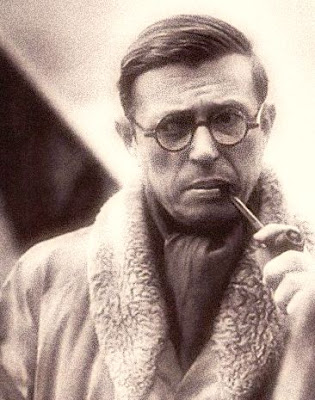
Jean-Paul Sartre [Wikipedia]
Jean-Paul Sartre [Stanford Encyclopedia of Philosophy]
Sartre’s Existentialism [International Encyclopedia of Philosophy]
Jean-Paul Sartre Archive
North American Sartre Society
No Exit text
And this from the BBC...
Jean-Paul Sartre..."In Camera" [aka "No Exit"]


The Writer's Almanac...
It's the birthday of philosopher and writer Jean-Paul Sartre...born in Paris (1905). This giant of existential thought was also a well-known prankster during his days at the École Normale. He and a friend dropped water balloons from the roof onto dinner guests in tuxedos, shouting, "Thus pissed Zarathustra!" He sometimes showed up naked to official functions, and he vomited on the feet of a school official. After Charles Lindbergh successfully flew across the Atlantic, Sartre and several of his friends announced to the media that Lindbergh would be receiving an honorary degree at the École Normale, then one of them impersonated Lindbergh and convinced the media that he was at the school. There was such an uproar when it turned out to be a hoax that the school's president was forced to resign.
In 1964, Sartre was awarded the Nobel Prize in literature, but he refused it. When he died in 1980, 50,000 people turned out on the streets of Paris to pay their respects.
He wrote: "I was there, standing in front of a window whose panes had a definite refraction index. But what feeble barriers! I suppose it is out of laziness that the world is the same day after day. Today it seemed to want to change. And then, anything, anything could happen."
Human, All too Human from the BBC...
Jean-Paul Sartre [Wikipedia]
Jean-Paul Sartre..."In Camera" [aka "No Exit"]
Simone de Beauvoir and Jean-Paul Sartre...an unconventional relationship
Here'ssssssssssssssssssss...Sartre!


The Writer's Almanac...
It's the birthday of the novelist and philosopher Simone de Beauvoir, born in Paris, France (1908). She entered the Sorbonne, and it was there that she met another philosophy student, Jean-Paul Sartre. He was five feet tall, had lost his sight in one eye, wore baggy clothes, and seemed to have no interest in hygiene. But he loved to talk, and he was both funny and brilliant. Beauvoir later said, "It was the first time in my life that I felt intellectually inferior to anyone else."
Sartre was equally impressed by Beauvoir's intellect, especially when she finished her philosophy degree in one year, after it had taken Sartre three years to finish his own. She was the youngest person to receive the degree in French history. They fell in love, but instead of getting married, they decided to form a pact. They would both have affairs with other people, but they would tell each other everything. That basic arrangement of their relationship would last for the rest of their lives.
They didn't even live together, but every evening they would meet in a café and show each other what they were working on. They each edited the other's work, and they gave each other ideas, and together they helped formulate the school of philosophy known as existentialism, which was the idea that human beings should consider themselves completely free to define their own existence, without regard to religion, culture, or society.
Sartre wrote his book Being and Nothingness (1943) about the new philosophy, and Beauvoir followed with a book of ethics based on the same ideas called The Ethics of Ambiguity (1947). But one of her most famous books was inspired by an offhand comment Sartre made one day. They were talking about the differences in the ways men and women were treated, and Beauvoir claimed that she'd never been adversely affected by this treatment. Sartre said, "All the same, you weren't brought up the same way a boy would have been; you should look into it further."
So Beauvoir did look into it. She spent weeks at the National Library in Paris researching the way women had been treated throughout history. The result was her book The Second Sex (1949), in which she wrote, "One is not born a woman, one becomes one." It was one of the first comprehensive arguments that the difference between the sexes was the result of culture, not nature, and it helped found the modern feminist movement.
Beauvoir went on to write many more books, including several volumes of autobiography, such as Memoirs of a Dutiful Daughter (1958), about her childhood, and The Prime of Life (1960), which tells the story of her relationship with Sartre and the years they spent together during World War II.
Simone de Beauvoir said, "The writer of originality, unless dead, is always shocking, scandalous; novelty disturbs and repels."
Simone de Beauvoir [Wikipedia]
New Horizons...
The original name of the play in French is “Huis Clos” or In Camera, which means a private discussion going on behind closed doors, as in a legal situation when deliberation goes on before a sentence is passed. In its English translation, the name has been changed and the play was performed under different other names such as “No Way out”, “Dead End” and “No Exit”.
There are three principal characters in the play who are locked into a room together as a form of punishment for their sins and life. The play is taking place in the afterlife and in particular in hell. The most famous quotation of Sartre, “l’enfer, c’est les autres” or “hell is other people” is the motto of the play.
Sartre was the first philosopher to use the term existentialism although existential philosophy goes back to the 19th century with philosophers like Kierkegaard and Nietzsche. Existentialist issues have been the focus of novels by Masters of literature such as Dostoevsky and Kafka. Their novels raised issues about absurdity of life and the dilemma of personal choice and man’s freedom with its consequent responsibility.
Existentialist believes that man creates his own existence; his being is formed once he discovers the absurdity of life, his freedom and his ability to make choices. Man makes his own existence through his choices and his actions, including ending his own existence. The realisation of freedom brings with it an existential sense of anxiety or “angst”. This feeling of anxiety makes some people choose to live inauthentic life or live “in bad faith”. People try to avoid their freedom, “escape from freedom” by attributing their actions to determinism of their genes or their past or rationality and the absolute values of society or traditions. When they build all their life on some fixed values or perceptions and suddenly they discover that all this is false, they go into despair.
Man’s existence is not only determined by his subjective experiences, choices and actions, but also by the existence of the Other. The Gaze of the Other limits his freedom and turn his subjectivity into an object.
In the play, No Exit or In Camera, this existential dilemma is clearly exposed. When Joseph Garcin is introduced into the room by the valet, the audience realises that this is a room in hell. The room has no Windows, no mirrors and only one door, which is locked. Later, Garcin is joined by another person, Ines Serrano, and then another woman join them, Estelle Rigault. The three are facing each other with open eyes and no mirrors to see themselves except in the eyes of the other. The actors and the audience discover that there is no torture in hell except the eyes of the others. They uncover each other’s sins, desires and unpleasant memories. This is a model of an encounter group were confrontation goes on with no prospects of end. Near the end of the play, Garcin shouts asking to be let out of the room, however when the door suddenly opens, he is unable to take the first step for fear of the unknown.
The audience discovered that Garcin, before he died, was working as a journalist and he refused to support the war of his country and so he was shot dead. He lived a life in bad faith unable to take the side of a good cause, and cheating on his wife. Near the end, when he refuses to walk out of the open door, he feels afraid of loneliness and unable to face his freedom and responsibility. He would rather stay in hell, and he prefers to become an object under the gaze of others.
Ines, a working class woman, who goes on torturing the other two in a sadist way, seems to be taking the role of the facilitator of the confrontation in the group. She forces the others to take responsibilities for their previous actions and drags them into confessions and agony of their memories. She make Garcin understand that he lacks the courage although he believes in a value system which proclaim this virtue. She makes him see himself as a coward. Ines, herself, is a lesbian who exposes the weakness of the other character, Estelle Rigault, a woman who makes her existence depends on the way men sees her.
Estelle Rigault is a Parisian society woman who made herself an object traded for money when she married a rich man older than her making excuses by supporting her family. She also cheated on this husband by having an affair with a young man and she got pregnant with a child whom she killed by drowning. Estelle needs the others to feed her existence, needs a man to desire her. She makes herself an object, as she is unable to take the responsibility for being free. Throughout the play, she asks Garcin to look at her, hold her, to touch her.
Both Garcin and Estelle are attached to their past and see their friends and loved ones back on Earth. Their existence is determined by their past in bad faith. Garcin justifies his existence by his “fate”, and he evaluates his past actions through the choices of other people. On the other hand, Ines considers her past as meaningless and she chooses to exist in the present. She cuts her attachment to the past and tells the other two that nothing is left of them on Earth and all what they have is here. Ines considers that the past sets her freedom and this has helped her to choose her essence in the present time. She is the only one of the three characters who was able to face her responsibility and her suffering at the same time. She is able to see the despair and yet to begin life on the other side of despair.
In Camera
1964
Jean-Paul Sartre [Wikipedia]
Jean-Paul Sartre [Stanford Encyclopedia of Philosophy]
Sartre’s Existentialism [International Encyclopedia of Philosophy]
Jean-Paul Sartre Archive
North American Sartre Society











!["Coupling" 1976 [Gum-bichromate]](http://2.bp.blogspot.com/_IoU3bEFUwWc/S69lnr9G6AI/AAAAAAAAH58/O40Gg-G6rKk/S150/COUPLING+3.jpg)