Showing posts with label Isaac Newton. Show all posts

Saturday, March 21, 2009

Goethe vs Newton--"Theory of Colours"

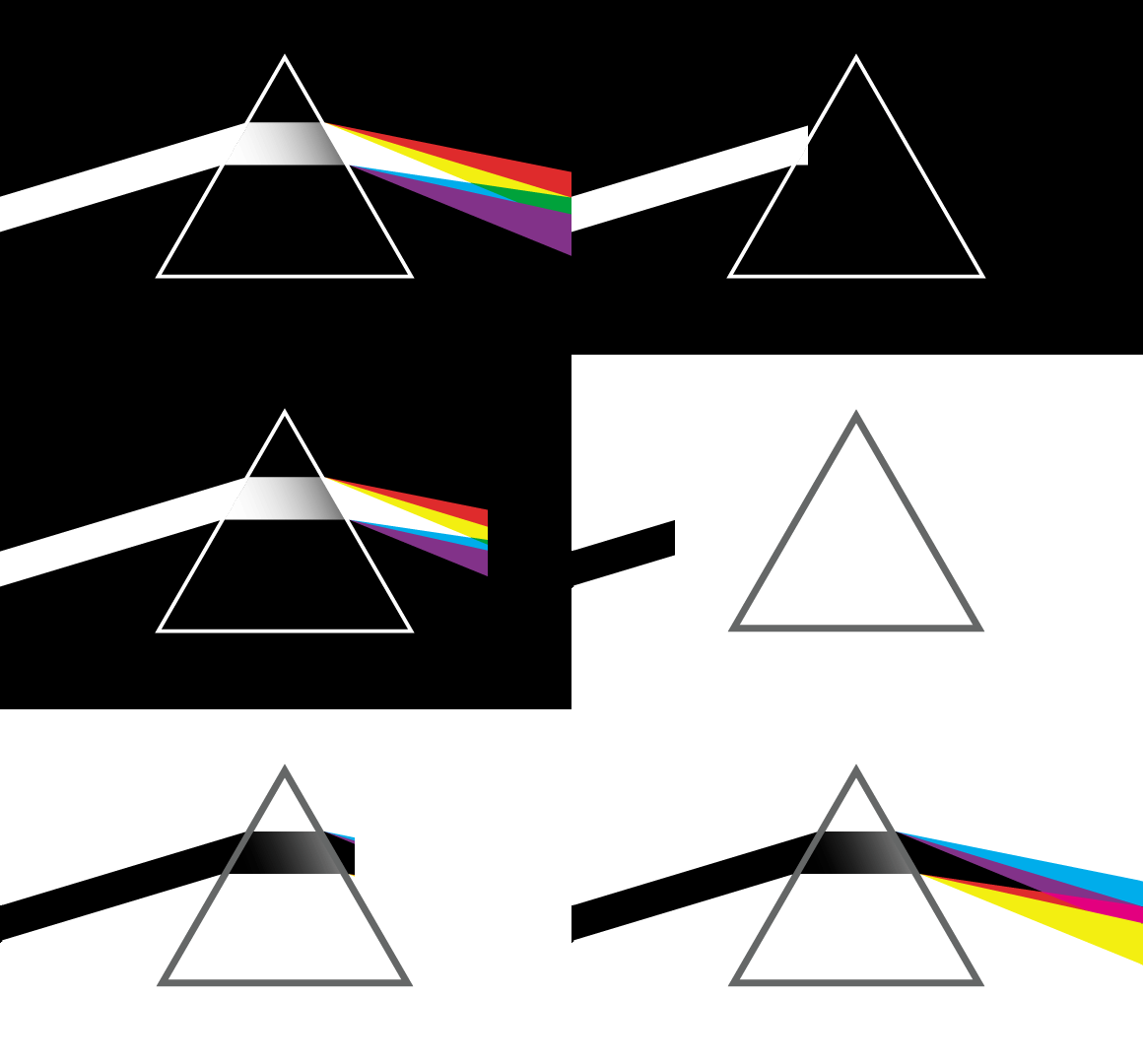
File:Prisma-goethe.gif

My periodic trip to a local thrift store revealed an old text by Goethe and his disagreement with Newton regarding the "theory of colors". While not totally accepted by all physicists it did attract the attention of philosophers [Wittgenstein] and some physicists [Heisenberg].

Best description and analysis...

Theory of Colours

Theory of Colours

by

Johann Wolfgang Goethe

ISBN-10: 0262570211
ISBN-13: 978-0262570213

Tuesday, December 30, 2008

More on Isaac Newton's birthday


"The Ten Days of Newton"

by

Olivia Judson

December 23rd, 2008

The New York Times

Some years ago, the evolutionist and atheist Richard Dawkins pointed out to me that Sir Isaac Newton, the founder of modern physics and mathematics, and arguably the greatest scientist of all time, was born on Christmas Day, and that therefore Newton's Birthday could be an alternative, if somewhat nerdy, excuse for a winter holiday.

Think of the merchandise! Newton is said to have discovered the phenomenon of gravity by watching apples fall in an orchard. (His insight came after pondering why they always fall down, rather than upwards or sideways.) Newton's Birthday cards could feature the great man discovering gravity by watching a Christmas decoration fall from a tree. (This is a little anachronistic — Christmas trees didn’t come to England until later — but I don't think we should let that get in the way.)

All very jolly — but then, 'tis the season. Yet things are not so simple. It turns out that the date of Newton's birthday is a little contentious. Newton was born in England on Christmas Day 1642 according to the Julian calendar — the calendar in use in England at the time. But by the 1640s, much of the rest of Europe was using the Gregorian calendar (the one in general use today); according to this calendar, Newton was born on Jan. 4, 1643.

Rather than bickering about whether Dec. 25 or Jan. 4 is the better date to observe Newton's Birthday, I think we should embrace the discrepancy and have an extended festival. After all, the festival of Christmas properly continues for a further 12 days, until the feast of the Epiphany on Jan. 6. So the festival of Newton could begin on Christmas Day and then continue for an extra 10 days, representing the interval between the calendars.

The reason the interval became necessary is that the Earth, inconveniently, does not orbit the sun in an exact number of days. Instead, the Earth's orbit is 365 days and a bit. The “bit” is just under a quarter of a day.

It wasn't always thus. Some 530 million years ago, when animals like the trilobites were skittering around, days had less time. Back then, a day was only 21 hours, and a year was about 420 days. In another 500 million years, perhaps a day will be 27 hours, and a year fewer than 300 days. Because of the friction exerted by the moon, the Earth is slowing down. Indeed, already the days are a tiny bit longer than they were 100 years ago.

Because the orbit isn't an exact number of days, our calendars get out of sync with the seasons unless we correct for the fractional day. The Julian calendar, which was put in place by Julius Caesar in 45 B.C., was the Romans' best effort at making a systematic correction. Before that, the Roman calendar gave 355 days to the basic year, and every other year was supposed to include an extra month of 22 or 23 days.

But over a period of 24 years, that gave too many days; so in some years, the extra month was supposed to be skipped. This didn't always happen. By the time the Julian calendar was introduced, the Roman calendar was so far out of sync with the seasons that the year before the first Julian year had to include a massive correction; that year, referred to as "the last year of confusion," was 445 days. Talk about a long year.

The Julian calendar, which is broadly similar to the one we have now, divided the year into 365 days and a quarter. To implement this practically, three out of four years were given 365 days, and the fourth, 366. But this still wasn’t precise enough: by the 16th century, the calendar had fallen 10 days out of sync with the solar year. By introducing a couple of extra fiddles to do with leap years at the ends of centuries, the Gregorian calendar fixed that. Again, however, changing calendars meant introducing a one-off correction to bring the dates back in line with the seasons. Rather than having a year with an extra 90 days like the Romans, Europeans “lost” 10 days as the calendar skipped forward. Hence the interval between the contending dates of Newton's Birthday.

It's strangely suitable that the length of the festival should be due to human efforts to describe the orbit of our planet. For planetary orbits were the subject of one of Newton's key works, "De Motu Corporum in Gyrum," ("On the Motion of Bodies in an Orbit"), which he sent to the astronomer Edmond Halley (of Halley’s comet fame) in November of 1684. The proofs and insights contained here were revolutionary, and allowed the calculation of the orbit of any object, from planet to comet or asteroid, moving through a gravitational field.

Shortly after sending "Motion" to Halley, Newton began work on the treatise for which he is most famous, "Philosophiae Naturalis Principia Mathematica" ("Mathematical Principles of Natural Philosophy") usually known simply as the Principia. This is where, among many other insights and discoveries, he articulated his three laws of motion, which students still learn in high school physics. He explained that gravity causes tides, and that the gravitational force of Jupiter perturbs the orbit of Saturn. The basis of many of his insights rested in a kind of mathematics he had invented as a private tool for himself years before: calculus.

Newton was not merely a thinker of abstract and complex thoughts, however. He had a gift with mechanical objects. As a child, he built a miniature working model of a windmill. As an adult, he built the first reflecting telescope.

He was also an experimenter. For example, his experiments with prisms showed that white light is composed of light of other colors. Although it had been known before Newton that shining a beam of sunlight through a prism would produce a rainbow, no one knew why: it was as though the prism created colors. Newton discovered the real reason: light is composed of different wavelengths that are refracted differently by the glass of the prism. The prism doesn’t create colors, it reveals them.

Physics was only one of his interests. He was deeply religious, though a heretic — he did not believe in the Holy Trinity — and he wrote more about religion than he did about physics, mathematics or his other great interest, alchemy. Though he never managed to turn base metal into gold in an experiment, later in life he became Warden of the Mint — the man in charge of making the country’s money. Here, he oversaw the production of gold and silver coins, and ensured that they were made more exactly than they had ever been made before. He also went after counterfeiters, several of whom were hanged.

Newton does not seem to have been a pleasant man. He feuded with several of his professional colleagues, most famously Robert Hooke and Gottfried Willhelm Leibniz; he was reclusive and secretive and seems to have formed few lasting friendships. But he was also a genius, and his work laid the foundations of our modern understanding of the world. He is a man to celebrate.

In honor of Newton’s Birthday festival, I therefore propose the following song, to be sung to the tune of "The Twelve Days of Christmas." For brevity, I include only the final verse. All together now!

On the tenth day of Newton,
My true love gave to me,
Ten drops of genius,
Nine silver co-oins,
Eight circling planets,
Seven shades of li-ight,
Six counterfeiters,
Cal-Cu-Lus!
Four telescopes,
Three Laws of Motion,
Two awful feuds,
And the discovery of gravity!

Happy Newton, everybody!

**********

NOTES:

I have drawn my account of the Roman calendars from the entry on "calendar" in the eleventh edition of the Encyclopedia Britannica. For days having been shorter when the trilobites were about, see Ravilious, K. "Wind-up." New Scientist: 23 November 2002. The details of Newton’s discoveries and life can be found in any biography; I drew on two, Berlinski, D. 2001. "Newton’s Gift." Duckworth; and Gleick, J. 2003. "Isaac Newton." Fourth Estate.

Many thanks to Thomas Levenson for insights, comments and suggestions.


December 25th--1642--Isaac Newton

[Thanks to POSP stringer Tim.]

Wednesday, December 24, 2008

December 25th--1642--Isaac Newton


Well, sort of a birthday, for it depends on which calendar is observed. There is no harm in celebrating the birth dates of two great men...a man of philosophy and a man of science.

During Newton's lifetime, two calendars were in use in Europe: the Julian or 'Old Style' in Britain and parts of northern Europe (Protestant) and eastern Europe, and the Gregorian or 'New Style', in use in Roman Catholic Europe and elsewhere. At Newton's birth, Gregorian dates were ten days ahead of Julian dates: thus Newton was born on Christmas Day, 25 December 1642 by the Julian calendar, but on 4 January 1643 by the Gregorian. By the time he died, the difference between the calendars had increased to eleven days. Moreover, prior to the adoption of the Gregorian calendar in the UK in 1752, the English new year began (for legal and some other civil purposes) on 25 March ('Lady Day', i.e. the feast of the Annunciation: sometimes called 'Annunciation Style') rather than on 1 January (sometimes called 'Circumcision Style').


Isaac Newton [1642-1727]

English physicist and mathematician who was born into a poor farming family. Luckily for humanity, Newton was not a good farmer, and was sent to Cambridge to study to become a preacher. At Cambridge, Newton studied mathematics, being especially strongly influenced by Euclid, although he was also influenced by Baconian and Cartesian philosophies. Newton was forced to leave Cambridge when it was closed because of the plague, and it was during this period that he made some of his most significant discoveries. With the reticence he was to show later in life, Newton did not, however, publish his results.

Newton suffered a mental breakdown in 1675 and was still recovering through 1679. In response to a letter from Hooke, he suggested that a particle, if released, would spiral in to the center of the Earth. Hooke wrote back, claiming that the path would not be a spiral, but an ellipse. Newton, who hated being bested, then proceeded to work out the mathematics of orbits. Again, he did not publish his calculations. Newton then began devoting his efforts to theological speculation and put the calculations on elliptical motion aside, telling Halley he had lost them. Halley, who had become interested in orbits, finally convinced Newton to expand and publish his calculations. Newton devoted the period from August 1684 to spring 1686 to this task, and the result became one of the most important and influential works on physics of all times, Philosophiae Naturalis Principia Mathematica (Mathematical Principles of Natural Philosophy) (1687), often shortened to Principia Mathematica or simply "the Principia."

In Book I of Principia, Newton opened with definitions and the three laws of motion now known as Newton's laws (laws of inertia, action and reaction, and acceleration proportional to force). Book II presented Newton's new scientific philosophy which came to replace Cartesianism. Finally, Book III consisted of applications of his dynamics, including an explanation for tides and a theory of lunar motion. To test his hypothesis of universal gravitation, Newton wrote Flamsteed to ask if Saturn had been observed to slow down upon passing Jupiter. The surprised Flamsteed replied that an effect had indeed been observed, and it was closely predicted by the calculations Newton had provided. Newton's equations were further confirmed by observing the shape of the Earth to be oblate spheroidal, as Newton claimed it should be, rather than prolate spheroidal, as claimed by the Cartesians. Newton's equations also described the motion of Moon by successive approximations, and correctly predicted the return of Halley's Comet. Newton also correctly formulated and solved the first ever problem in the calculus of variations which involved finding the surface of revolution which would give minimum resistance to flow (assuming a specific drag law).

Newton invented a scientific method which was truly universal in its scope. Newton presented his methodology as a set of four rules for scientific reasoning. These rules were stated in the Principia and proposed that (1) we are to admit no more causes of natural things such as are both true and sufficient to explain their appearances, (2) the same natural effects must be assigned to the same causes, (3) qualities of bodies are to be esteemed as universal, and (4) propositions deduced from observation of phenomena should be viewed as accurate until other phenomena contradict them.

These four concise and universal rules for investigation were truly revolutionary. By their application, Newton formulated the universal laws of nature with which he was able to unravel virtually all the unsolved problems of his day. Newton went much further than outlining his rules for reasoning, however, actually describing how they might be applied to the solution of a given problem. The analytic method he invented far exceeded the more philosophical and less scientifically rigorous approaches of Aristotle and Aquinas. Newton refined Galileo's experimental method, creating the compositional method of experimentation still practiced today. In fact, the following description of the experimental method from Newton's Optics could easily be mistaken for a modern statement of current methods of investigation, if not for Newton's use of the words "natural philosophy" in place of the modern term "the physical sciences." Newton wrote, "As in mathematics, so in natural philosophy the investigation of difficult things by the method of analysis ought ever to precede the method of composition. This analysis consists of making experiments and observations, and in drawing general conclusions from them by induction...by this way of analysis we may proceed from compounds to ingredients, and from motions to the forces producing them; and in general from effects to their causes, and from particular causes to more general ones till the argument end in the most general. This is the method of analysis: and the synthesis consists in assuming the causes discovered and established as principles, and by them explaining the phenomena preceding from them, and proving the explanations."

Newton formulated the classical theories of mechanics and optics and invented calculus years before Leibniz. However, he did not publish his work on calculus until afterward Leibniz had published his. This led to a bitter priority dispute between English and continental mathematicians which persisted for decades, to the detriment of all concerned. Newton discovered that the binomial theorem was valid for fractional powers, but left it for Wallis to publish (which he did, with appropriate credit to Newton). Newton formulated a theory of sound, but derived a speed which did not agree with his experiments. The reason for the discrepancy was that the concept of adiabatic propagation did not yet exist, so Newton's answer was too low by a factor of , where is the ratio of heat capacities of air. Newton therefore fudged his theory until agreement was achieved.

In Optics (1704), whose publication Newton delayed until Hooke's death, Newton observed that white light could be separated by a prism into a spectrum of different colors, each characterized by a unique refractivity, and proposed the corpuscular theory of light. Newton's views on optics were born out of the original prism experiments he performed at Cambridge. In his "experimentum crucis" (crucial experiment), he found that the image produced by a prism was oval-shaped and not circular, as current theories of light would require. He observed a half-red, half-blue string through a prism, and found the ends to be disjointed. He also observed Newton's rings, which are actually a manifestation of the wave nature of light which Newton did not believe in. Newton believed that light must move faster in a medium when it is refracted towards the normal, in opposition to the result predicted by Huygens's wave theory.

Newton also formulated a system of chemistry in Query 31 at the end of Optics. In this corpuscular theory, "elements" consisted of different arrangements of atoms, and atoms consisted of small, hard, billiard ball-like particles. He explained chemical reactions in terms of the chemical affinities of the participating substances. Newton devoted a majority of his free time later in life (after 1678) to fruitless alchemical experiments.

Newton was extremely sensitive to criticism, and even ceased publishing until the death of his arch-rival Hooke. It was only through the prodding of Halley that Newton was persuaded at all to publish the Principia Mathematica. In the latter portion of his life, he devoted much of his time to alchemical researches and trying to date events in the Bible. After Newton's death, his burial place was moved. During the exhumation, it was discovered that Newton had massive amounts of mercury in his body, probably resulting from his alchemical pursuits. This would certainly explain Newton's eccentricity in late life. Newton was appointed Warden of the British Mint in 1695. Newton was knighted by Queen Anne. However, the act was "an honor bestowed not for his contributions to science, nor for his service at the Mint, but for the greater glory of party politics in the election of 1705".

Newton singlehandedly contributed more to the development of science than any other individual in history. He surpassed all the gains brought about by the great scientific minds of antiquity, producing a scheme of the universe which was more consistent, elegant, and intuitive than any proposed before. Newton stated explicit principles of scientific methods which applied universally to all branches of science. This was in sharp contradistinction to the earlier methodologies of Aristotle and Aquinas, which had outlined separate methods for different disciplines.

Although his methodology was strictly logical, Newton still believed deeply in the necessity of a God. His theological views are characterized by his belief that the beauty and regularity of the natural world could only "proceed from the counsel and dominion of an intelligent and powerful Being." He felt that "the Supreme God exists necessarily, and by the same necessity he exists always and everywhere." Newton believed that God periodically intervened to keep the universe going on track. He therefore denied the importance of Leibniz's vis viva as nothing more than an interesting quantity which remained constant in elastic collisions and therefore had no physical importance or meaning.

Although earlier philosophers such as Galileo and John Philoponus had used experimental procedures, Newton was the first to explicitly define and systematize their use. His methodology produced a neat balance between theoretical and experimental inquiry and between the mathematical and mechanical approaches. Newton mathematized all of the physical sciences, reducing their study to a rigorous, universal, and rational procedure which marked the ushering in of the Age of Reason. Thus, the basic principles of investigation set down by Newton have persisted virtually without alteration until modern times. In the years since Newton's death, they have borne fruit far exceeding anything even Newton could have imagined. They form the foundation on which the technological civilization of today rests. The principles expounded by Newton were even applied to the social sciences, influencing the economic theories of Adam Smith and the decision to make the United States legislature bicameral. These latter applications, however, pale in contrast to Newton's scientific contributions.

It is therefore no exaggeration to identify Newton as the single most important contributor to the development of modern science. The Latin inscription on Newton's tomb, despite its bombastic language, is thus fully justified in proclaiming, "Mortals! rejoice at so great an ornament to the human race!" Alexander Pope's couplet is also apropos: "Nature and Nature's laws lay hid in night; God said, Let Newton be! and all was light."--scienceworld.wolfram.com


Newton and 2060

Robert Hooke's "Micrographia..."