Showing posts with label Hubble Space Telescope. Show all posts

Monday, October 17, 2011

Mother of the Hubble Space Telescope...Nancy Grace Roman


"NASA fellowship named for UU astronomer"

Known as “Mother of the Hubble,” Nancy Grace Roman hopes to inspire girls to pursue
careers in science.

by

Donald E. Skinner

October 17th, 2011

Unitarian Universalist Association of Congregations

For 20 years until she retired in 1979, Dr. Nancy Grace Roman was NASA’s chief astronomer, and also the first person to hold that title. As part of that job she helped design the Hubble Space Telescope, earning her the unofficial title of “Mother of the Hubble.” And now NASA has honored her by creating the Nancy Grace Roman Technology Fellowships in Astrophysics.

That puts her in good company. NASA’s three other astrophysics fellowships are named for Edwin Hubble, Albert Einstein, and Carl Sagan.

Roman, 86, an active and longtime member of River Road Unitarian Universalist Congregation in Bethesda, Md., says she had the good fortune to be born to parents in 1925 in Nashville who shared their love of science and nature with her. Her father was a geophysicist who encouraged her scientific questions. Her mother, a teacher, introduced her to birds, plants, and constellations.

Roman grew up loving the stars. At age four her favorite thing to draw was the moon. At 11, she organized an astronomy club with her friends. In school she read everything she could find about astronomy in the Baltimore library. She studied it at Swarthmore College, then got her PhD in it at the University of Chicago in 1949. She joined NASA in 1959, a few months after its formation, to set up a program of astronomy from space.

As part of her job she traveled around the country trying to learn what astronomers wanted from NASA. She knew they wanted space observations from above the atmosphere, because “Looking through the atmosphere is somewhat like looking through a piece of old, stained glass,” she said. But how did they want to use NASA’s early capabilities?

She set up a committee of astronomers, plus NASA engineers, to decide how to get those observations. The Hubble was a result. It was carried into orbit by a space shuttle in 1990 and remains in service.

In an interview this past summer with Voice of America, Dr. Edward Weiler, who was chief scientist of the Hubble Space Telescope from 1979 to 1998, described Roman’s role in creating the Hubble. “. . . history has forgotten a lot in today’s Internet age, but it was Nancy in the old days before the Internet and before Google and email and all that stuff who really helped to sell the Hubble Space Telescope, organize the astronomers, who eventually convinced Congress to fund it.”

Roman has had no shortage of honors over the years. In 1962 Life magazine named her as one of the 100 most important young people in America. In 1987 an asteroid, Roman 1987, was named for her.

She is currently writing her autobiography. “I hope it will be an inspiration to young girls to think about a career in science,” she said.

She has Unitarian roots that run deep. Her parents were members of a Nashville congregation in the 1920s. “I believe that makes me a birthright Unitarian, although in a few years we moved to an area where there was no Unitarian congregation,” she said. Then came a move to Baltimore, where there was a church. “My father taught my Sunday school class, but there were only two of us in it, and I finally decided I didn’t have to get up on Sunday morning to be taught by my father.”

She also attended another Unitarian congregation in Washington many years ago. “In one sermon the minister said if you believe in God you don’t belong here. I went home and thought about it that afternoon. I decided I did not believe in a god in a human image. But I did believe in God. When I say I believe in God, it’s a recognition that the universe is bigger than the earth. I also can’t accept man as the top of the universe.”

She said she also considers herself Christian, “although I do not believe in the divinity of Jesus,” she said. “But our congregations celebrate Christian holidays and our music and art is largely based on Christianity. I’m really a Christian even though a lot of Christians would deny it.”

Roman added, “I think that the fact that my willingness to buck tradition, especially when people told me science was not a role for women, as they often did when I was young, may have been influenced by the fact I had been brought up to think away from tradition. Unitarianism got me thinking independently and perhaps gave me the courage to fight tradition.”

She has taught Sunday school at Davies Memorial UU Church in Camp Springs, Md., and has spoken to classes at River Road, where she has also presented her “Reflections on a Lifetime” at a Sunday morning forum. She has taught adult classes and ushered. Many people know her as the person who stands between the sanctuary and the fellowship hall on Sunday mornings, holding the small red box for money for local food banks. A party is being planned for her at River Road on Oct. 23.

The Rev. Ginger Luke, minister of religious education and congregational life at River Road, knows Roman (known at church as Nancy Grace) well. “Nancy Grace is so modest she waited almost a month before she told me of this honor from NASA. I am so glad she did, because somehow her recent honor from NASA seems like an honor for all of us. She has opened our eyes and our minds to the beauty and mystery of space and to the remarkable vitality and wisdom of a tiny grey-haired woman who every day lives out her Unitarian Universalist values and faith. She has awakened us to our own pride in seeing a brilliant woman excel and be honored.”

Mother of the Hubble Space Telescope [Swarthmore College]

Nancy Roman [Wikipedia]

Nancy Grace Roman Bio [NASA]

Thursday, October 2, 2008

Time to retire the Hubble Space Telescope

Edwin Hubble

The Hubble Space Telescope has served well in its short tenure and will for a while provide more breathtaking photographs. Nothing lasts forever, especially mechanical devices. It just isn't safe or cost effective to send a crew for repairs. Perhaps there may be an outside opportunity for robotic repairs. But there are new and improved instruments on the horizon and who knows...maybe a Hubble Space Telescope II. Technology just keeps improving and perhaps better gyroscopes and batteries will be invented.

The Hubble Space Telescope is getting old now since its rocky initial problems and became operational in 1993. It’s time to be replaced and such a plan is now being developed. The HST has done well indeed, for in the first five years of use, it has examined 10,000 celestial bodies, taken more than 100,000 photographs, and revealed 50 billion galaxies in the universe. Its 13 billion light years range has been exhausted. Granted its computer was updated but it was outdated while being installed. So scientists are thinking of retiring HST and making bigger and better improvements. For one thing, the diameter of the optics will increase from eight foot to 27 feet and, even better, relocate the telescope--place it further away from light interference.

There are complimentary telescopes that have supported HST: Space Infrared Telescope Facility (SIRTF) and Chandra X-ray telescope.

First Photo From New Space Telescope, SIRTF

History of X-Ray Astronomy

And the new James Webb Space Telescope [NGST (New Generation Space Telescope)]

Hubble's Mission and Beyond

The James Webb Space Telescope

Competition for Hubble and Hubble-like space telescopes is the feasible and cost effective "Dome C" site [two miles above sea level] right here on Earth so claim a group from the University of New South Wales. A long time enemy of terrestrial telescopes was atmospherics and thus mountains were sought such as in Chile, Hawaii, or the Canary Islands. The Hubble was free of atmospherics but prone to maintenance periods. The costs for Hubble were enormous: The craft itself, deployment, repair trips, replacement parts. The proposed telescope [The Douglas Mawson Telescope] would be located in the Antarctic and at a far less cost: About 700 million as compared to Hubble's initial launch of two plus billion. The structure would be made from concrete-like "icecrete" and the mirrors made from architectural window glass. Astronomers and the like wouldn't even have to visit the telescope for all could be done remotely by computers. There may be a hearty group of watchers and maintenance people to monitor the site. Incidentally, the Antarctic telescope would be limited to infrared and optical observations. Sounds like a good idea. Any drawbacks...other than freezing?

Astronomy in the deep freeze


Hubble Telescope

Saturday, April 5, 2008

False astronomy colors and epistemology?

This in essence is a question of epistemology and the truth of the knowledge of what is presented to us via terrestrial and "in space" instruments that provide us photographs of objects beyond Earth. I vacillate between the Spitzer and Hubble images for one day Hubble provides a cool image and then is replaced by one from Spitzer. Okay, both provide good images. In spite of the data gleaned and the hypotheses formed, the question I have is in the "representation" of the images. Often, the caption will read as in the above image--"This false-color image from NASA's Spitzer Space Telescope shows a dying star (center) surrounded by a cloud of glowing gas and dust." "False-color"? At the bottom of the captioned image is a small technical statement: "This image composite was taken on Dec. 6, 2003, by Spitzer's infrared array camera, and is composed of images obtained at four wavelengths: 3.6 microns (blue), 4.5 microns (green), 5.8 microns (orange) and 8 microns (red)." Okay, this is somewhat like the four color engraving printing process of days of old when separation negatives were made: Yellow, red, blue, and black--each separation negative run through the printing press in succession yielding a full color print. [This process is akin to the old Tri-color Technicolor motion picture film process and the early Eastman Kodak Kodachrome process--the "dye transfer" method.] Now the question is, is this done strictly by computer manipulation and who is responsible for adjusting the hue and intensity that produces these fantastic images? Isn't that methodology subjective? It verges on "art"...and that after all is a matter of preference. I think we assume that what we are shown is what actually exists [color wise] and that is the problem of epistemology for it is wrong as a source of knowledge. I'll grant that the space enhanced photographs are spectacular to view, but it does also represent a false source of epistemology and I bet that most people asume that what they witness is true of the objects representation.

The official words from NASA's Hubble site:

Taking color pictures with the Hubble Space Telescope is much more complex than taking color pictures with a traditional camera. For one thing, Hubble doesn't use color film - in fact, it doesn't use film at all. Rather, its cameras record light from the universe with special electronic detectors. These detectors produce images of the cosmos not in color, but in shades of black and white.

Finished color images are actually combinations of two or more black-and-white exposures to which color has been added during image processing.

The colors in Hubble images, which are assigned for various reasons, aren't always what we'd see if we were able to visit the imaged objects in a spacecraft. We often use color as a tool, whether it is to enhance an object's detail or to visualize what ordinarily could never be seen by the human eye.

Color in Hubble images is used to highlight interesting features of the celestial object being studied. It is added to the separate black-and-white exposures that are combined to make the final image.

Creating color images out of the original black-and-white exposures is equal parts art and science.

We use color:

1.) To depict how an object might look to us if our eyes were as powerful as Hubble
2.) To visualize features of an object that would ordinarily be invisible to the human eye
3.) To bring out an object's subtle details.

Light from astronomical objects comes in a wide range of colors, each corresponding to a particular kind of electromagnetic wave. Hubble can detect all the visible wavelengths of light plus many more that are invisible to human eyes, such as ultraviolet and infrared light.

Astronomical objects often look different in these different wavelengths of light. To record what an object looks like at a certain wavelength, Hubble uses special filters that allow only a certain range of light wavelengths through. Once the unwanted light has been filtered out, the remaining light is recorded.

Hubble's many filters allow it to record images in a variety of wavelengths of light. Since the cameras can detect light outside the visible light spectrum, the use of filters allows scientists to study "invisible" features of objects - those only visible in ultraviolet and infrared wavelengths.

Many full-color Hubble images are combinations of three separate exposures - one each taken in red, green, and blue light. When mixed together, these three colors of light can simulate almost any color of light that is visible to human eyes. That’s how televisions, computer monitors, and video cameras recreate colors.

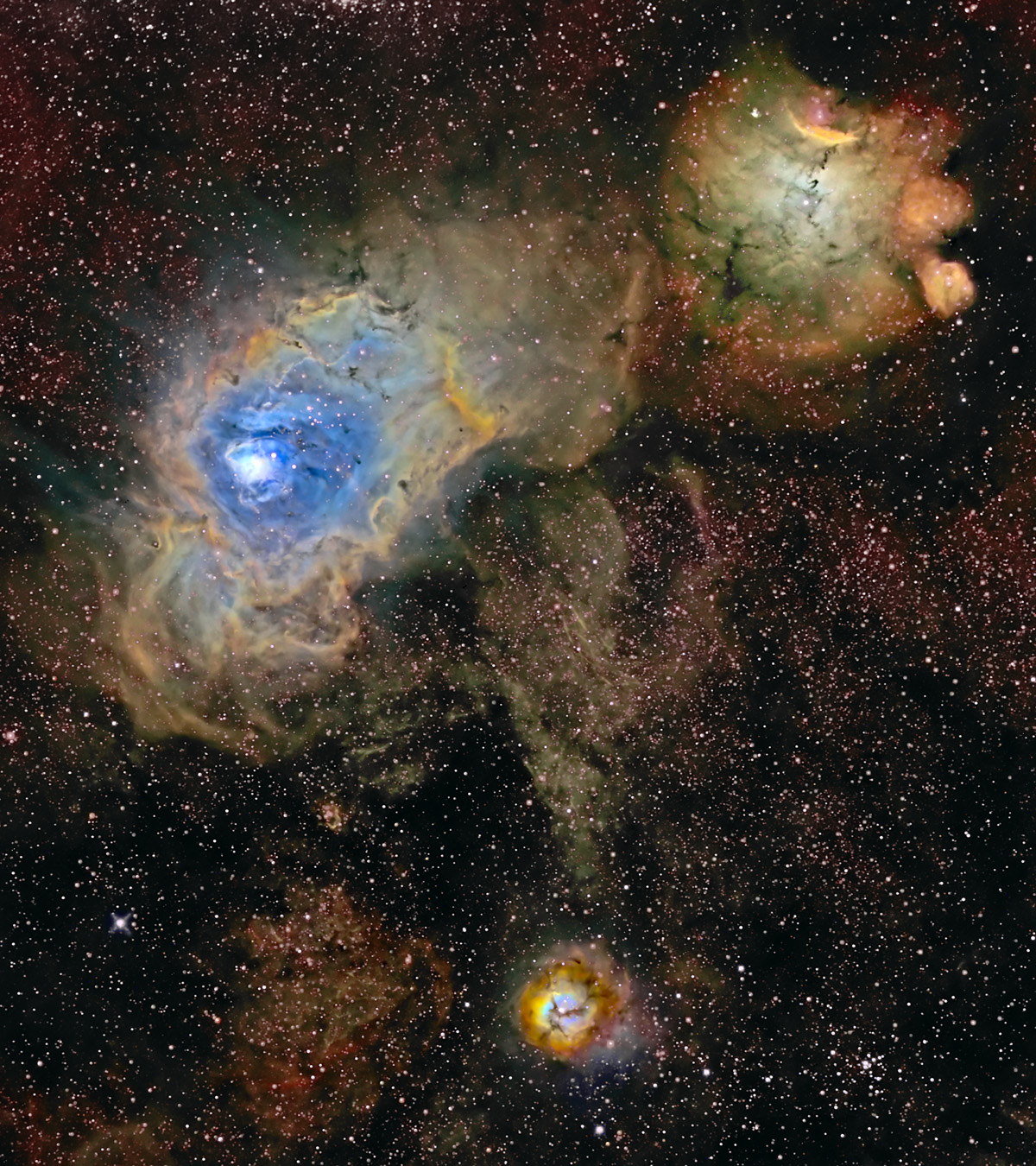
Recent Example...

See Explanation.  Clicking on the picture will download  the highest resolution version available.

Three Nebulae in Narrow Band

Narrow band filters and a false-color palette give these three nebulae a stunning appearance against the cosmic canvas of the central Milky Way. All three are stellar nurseries about 5,000 light-years or so distant, toward the nebula rich constellation Sagittarius. In the 18th century, astronomer Charles Messier cataloged two of them; colorful M8, above and right of center, and compact M20 at the left. The third, NGC 6559, is at bottom right. Over a hundred light-years across, M8 is also known as the Lagoon Nebula. Divided by obscuring dust lanes, M20's popular moniker is the Trifid. In the composite image, narrow emission lines from sulfur, hydrogen, and oxygen atoms recorded through the filters, are mapped into broader red, green, and blue colors respectively. The color scheme was made popular in Hubble Space Telescope images. But for ground-based telescopes, narrow band filters also make it possible to reject overwhelming light-pollution and capture compelling images of the cosmos from urban skies.