Showing posts with label Egyptology. Show all posts

Wednesday, August 15, 2012

New Egyptian pyramids found by using NASA technology


"Lost Egyptian Pyramids Found?"

by

Rossella Lorenzi

August 10th, 2012

DiscoveryNews

Two possible pyramid complexes might have been found in Egypt, according to a Google Earth satellite imagery survey.

Located about 90 miles apart, the sites contain unusual grouping of mounds with intriguing features and orientations, said satellite archaeology researcher Angela Micol of Maiden, N.C.

One site in Upper Egypt, just 12 miles from the city of Abu Sidhum along the Nile, features four mounds each with a larger, triangular-shaped plateau.

The two larger mounds at this site are approximately 250 feet in width, with two smaller mounds approximately 100 feet in width.

The site complex is arranged in a very clear formation with the large mound extending a width of approximately 620 feet -- almost three times the size of the Great Pyramid.

"Upon closer examination of the formation, this mound appears to have a very flat top and a curiously symmetrical triangular shape that has been heavily eroded with time," Micol wrote in her website Google Earth Anomalies.

Intriguingly, when zooming in on the top of the triangular formation, two circular, 20-foot-wide features appear almost in the very center of the triangle.

Some 90 miles north near the Fayoum oasis, the second possible pyramid complex contains a four-sided, truncated mound that is approximately 150 feet wide.

"It has a distinct square center which is very unusual for a mound of this size and it almost seems pyramidal when seen from above," Micol wrote.

Located just 1.5 miles south east of the ancient town of Dimai, the site also contains three smaller mounds in a very clear formation, "similar to the diagonal alignment of the Giza Plateau pyramids," Micol stated in a press release.

"The color of the mounds is dark and similar to the material composition of Dimai's walls which are made of mudbrick and stone," the researcher wrote.

Founded in the third century B.C. under the Ptolemaic king Ptolemy II Philadelphus (309 B.C.–246 B.C.), Dimai was built on top of an earlier neolithic settlement.

Also known as Dimeh al-Siba, Dimeh of the Lions, the town is surrounded by a mudbrick wall that stretches up to 32 feet high and 16 feet thick, and features at its center a ruined stone temple dedicated to the crocodile god Soknopaios.

Indeed, the town's Greek name, Soknopaiou Nesos, means "Island of Soknopaios."

Well known to scholars for the amount of papyri and other inscribed material found among its ruins, Dimai reached its peak during the first and second century A.D. thanks to a major trade route. It was abandoned during the mid-third century A.D.

According to Micol, both sites have been verified as undiscovered by Egyptologist and pyramid expert Nabil Selim, whose findings include the pyramid called Sinki at Abydos and the Dry Moat surrounding the Step pyramid complex at Saqqara.

Selim found that the smaller 100-foot mounds at the site near Abu Sidhum are a similar size as the 13th Dynasty Egyptian pyramids, if a square base can be discovered.

"The images speak for themselves. It's very obvious what the sites may contain but field research is needed to verify they are, in fact, pyramids," Micol said.

The researcher has previously located several possible archaeological sites with Google Earth, including a potential underwater city off the coast of the Yucatan peninsula.

She believes the use of infrared imagery will allow scientists to see the extent of the complexes in greater detail.

The sites have been sent to Egyptologists and researchers for further investigation and "ground truthing," she said.

Wednesday, July 13, 2011

Zahi Hawass' glow may be fading


Frankly, Zahi Hawass has been riding high for some time...accountability now.

"Revolution Dims Star Power of Egypt’s Antiquities Chief"

by

Kate Taylor

July 12th, 2011

The New York Times

Until recently Zahi Hawass, Egypt’s antiquities minister, was a global symbol of Egyptian national pride. A famous archaeologist in an Indiana Jones hat, he was virtually unassailable in the old Egypt, protected by his success in boosting tourism, his efforts to reclaim lost artifacts and his closeness to the country’s first lady, Suzanne Mubarak.

But the revolution changed all that.

Now demonstrators in Cairo are calling for his resignation as the interim government faces disaffected crowds in Tahrir Square.

Their primary complaint is his association with the Mubaraks, whom he defended in the early days of the revolution. But the upheaval has also drawn attention to the ways he has increased his profile over the years, often with the help of organizations and companies with which he has done business as a government official.

He receives, for example, an honorarium each year of as much as $200,000 from National Geographic to be an explorer-in-residence even as he controls access to the ancient sites it often features in its reports.

He has relationships — albeit ones he says he does not profit from — with two American companies that do business in Egypt.

One, Arts and Exhibitions International, secured Mr. Hawass’s permission several years ago to take some of the country’s most precious treasures, the artifacts of King Tut, on a world tour; its top executives recently started a separate venture to market a Zahi Hawass line of clothing.

A second company, Exhibit Merchandising, has been selling replicas of Mr. Hawass’s hat for several years. Last year that company was hired to operate a new store in the Egyptian Museum in Cairo.

Mr. Hawass says his share of the profits from those products goes directly to Egyptian charities. But the fact that both charities, a children’s cancer hospital and a children’s museum, were overseen by Ms. Mubarak before the revolution has angered some critics.

“We don’t know how Egyptians lived all this time under this government or under these people,” said Entessar Gharieb, a radio announcer with a degree in archaeology who helped organize a recent protest calling for Mr. Hawass’s removal. “Zahi Hawass was one of this system, the system of Hosni Mubarak.”

Remarkably, given his Mubarak ties, Mr. Hawass has been able to hold on to his government post through the aftershocks of the revolution, though he resigned briefly in March and was reinstated. He travels a lot, serving as a cultural ambassador, praising the revolution and urging foreigners to visit Egypt. This month Peru honored him for his help in securing the return of artifacts that had been taken from Machu Picchu nearly a century ago.

“You can feel the energy in the air when he speaks to people about Egypt,” said John Norman, the president of Arts and Exhibitions International, which runs the Tut tour.

Nonetheless, Mr. Hawass remains dogged at home by unflattering reports in newspapers and on television. The gift shop at the Egyptian Museum had to be closed after a dispute over how the contract was awarded threatened to land him in jail. And critics have gone to Egyptian prosecutors with complaints about Mr. Hawass’s relationship with National Geographic and other matters.

“I have never done anything at all contrary to Egyptian law,” Mr. Hawass said in an e-mail response to questions. “Egyptian law permits government employees to accept honoraria and fees through outside contracts.”

The accusations against Mr. Hawass are much less serious than those made against other former government officials, but they show how quickly the landscape has tilted.

“I think he’s going to have to realize that there is a new way of doing business, or at least there may be,” said Michael C. Dunn, the editor of The Middle East Journal, a scholarly publication.

National Geographic first brought Mr. Hawass on as an explorer-in-residence, one of 16 it has around the world, in 2001 when he was director of the Giza pyramids. He has appeared in numerous National Geographic films about ancient Egypt, and the organization publishes some of his books and arranges his speaking engagements, for which he asks $15,000.

It is not clear how the National Geographic payments compare in size to Mr. Hawass’s government salary, which he would not disclose. National Geographic says it pays Mr. Hawass to advise it on major discoveries and help shape its policies on antiquities issues. It says it has never received preferential access to archaeological sites or discoveries.

Mr. Hawass said his impartiality was evident when the Discovery Channel won out over National Geographic in a bid to make films about DNA research on royal mummies.

“All proposals about films go before a committee,” he said in an e-mail, “and decisions are made to maximize both the scientific results and the profit for Egypt.”

But Mr. Hawass also said this week that he has decided to resign temporarily as a National Geographic explorer so that he can focus on protecting antiquities.

Mr. Hawass’s relationship with Arts and Exhibitions International dates back to 2003, when it approached him about staging a tour of Tutankhamen artifacts. Two Tut exhibitions organized by the company have traveled to 15 cities so far.

By the time the tours end in 2013, they will have brought Egypt close to $100 million, much more than the country reaped from the first United States tour of Tut artifacts in the 1970s, the organizers say.

Under the contract with Egypt, the organizers also donated $2 million to what was then known as the Suzanne Mubarak Children’s Museum, according to Mr. Norman, the president of Arts and Exhibitions International.

Mr. Norman said there is no connection between the Hawass clothing line, which he is producing under a separate venture, Adventure Clothing, and the Tut tour, which was negotiated years earlier. The clothing, he said, is just an effort on Mr. Hawass’s part “to leverage his image to benefit Egypt, which to me seems like a good thing.”

Mr. Hawass said his share of any profits will go to the Children’s Cancer Hospital in Cairo.

Mr. Norman started Exhibit Merchandising in 2004 to run the souvenir shops for the Tut exhibitions, but he and his partners sold the company in 2007. It continues to make the Hawass hat and run the Tut souvenir shops.

Mr. Hawass has said the hats have raised about $500,000 for charity, a figure that Exhibit Merchandising characterized as too high.

Last year, when Egypt looked to open the new, larger souvenir store at the Egyptian Museum, Mr. Hawass’s agency awarded the contract to a state-owned entity that then hired Exhibit Merchandising to run the store.

The award was challenged in court by the operator of a bookstore, Farid Atiya, who said he had hoped to compete but had been unfairly excluded from the bidding.

“These were the days before Mubarak fell,” he said in an interview, “and they were behaving as though power would stay forever with them.”

The court found that Mr. Atiya had been treated unfairly and ordered the contract rebid. Last April an Egyptian criminal court sentenced Mr. Hawass to a year in prison for defying that court order, but Mr. Hawass appealed and closed the new museum store. His sentence was lifted and a new contract will be awarded.

Curt Bechdel, a vice president with Exhibit Merchandising, said that Egyptian officials wanted his company because they were familiar with the Tut exhibit shops and they “wanted a well-run, Western approach to retail,” rather than something like Mr. Atiya’s store, which he characterized as less sophisticated.

“The fact that we sold his hat had nothing to do with” the award, added Mr. Bechdel, who said his company had no direct role in the bidding.

On Monday, Prime Minister Essam Sharaf of Egypt said he planned to replace several ministers this week. It was not clear whether Mr. Hawass will be among them.

“I’m starting to really feel that he has 10 lives, more than cats,” said Randa Baligh, an archaeologist at Mansoura University north of Cairo.

Mr. Hawass said he agreed to resume his position in March only after the interim government assured him that it would work to protect Egyptian monuments.

“I am not an elected official,” he said in an e-mail, “so the question of public support is not relevant to my position.”

“I am not a politician,” he added. “I am an archaeologist.”

Monday, June 16, 2008

Pyramids probe by physics

Now physics will probe the ancient pyramids.

"Secrets of the Pyramids"

by

Haley Bridger

Symmetry

March/April 2008

Volume 5, Issue 2

In a boon for archaeology, particle physicists plan to probe ancient structures for tombs and other hidden chambers. The key to the technology is the muon, a cousin of the electron that rains harmlessly from the sky.

In the dense jungles of northwestern Belize, the sound of metal hitting rock startles flocks of tropical birds and troops of black howler monkeys. Archaeologist Norman Hammond and his team stop digging. They have hit a stone wall 10 feet below ground; inside is a royal tomb. After almost one hundred test excavations at La Milpa, an ancient Mayan city of 50,000 people, Hammond has unearthed something big. Within the tomb lie the remains of a man wearing a jade pendant in the form of a vulture's head. He is thought to be either Bird Jaguar, the fifth-century ruler of La Milpa, or one of Bird Jaguar’s successors. And finding him was an incredible stroke of luck. Hammond made his famous discovery more than 10 years ago, but repeated efforts to find other tombs at the site have come up empty-handed. Lacking an ancient map of La Milpa or blueprints for its five pyramid mounds and buried plaza, archaeologists rely mostly on instinct. They run the risk of piercing priceless relics with their shovels or digging fruitlessly for years. The ground beneath the site "could be Swiss cheese, for all we know," riddled with burial chambers, tunnels, and hidden entrances, says Hammond, who is based at Boston University. Now researchers hope to find those hidden spaces with the help of particle physics.

A cosmic X-ray machine

The key to the new approach is the muon, a heavy cousin of the electron that's created when cosmic rays hit the atmosphere. Muons pass harmlessly through people and buildings; in fact, nearly 600 of them fly through your body each minute. They fascinate scientists because they’re one of the few high-energy particles raining down from the sky that can be examined for clues to the nature of the cosmos. Particle physicists started building muon detectors in the 1940s and they're still at it today; the most advanced particle detectors in the world, at the Large Hadron Collider in Geneva, Switzerland, have components that record muons created in particle collisions. But it's the ability of the muon to penetrate deep into rock and water that has archaeologists excited. Muons traveling through rock or other dense material will slow and eventually stop, while those flying through empty spaces keep going fullspeed. The idea is to catch the muons after they’ve passed through an archaeological site and measure their energies and trajectories. With this information, researchers can reconstruct their paths and compile a 3D image that reveals hidden chambers or other voids.

La Milpa

Scientists at the University of Texas at Austin plan to place two muon detectors on either side of a pyramid at La Milpa in Belize. This arrangement gives them a stereo view of the site, making it easier to compile a 3D image.

If archaeologists are like surgeons probing a patient, physicists are the radiologists whose X-rays show where to cut and how to do it safely. Just as X-rays leave patients unscarred, muons offer a way to explore ancient ruins without disturbing them. This fall, a team led by Arturo Menchaca-Rocha of the National Autonomous University of Mexico, or UNAM, plans to place a muon detector beneath the Pyramid of the Sun in Teotihuacán, northwest of Mexico City. Meanwhile, Roy Schwitters of the University of Texas at Austin is making plans to install muon detectors in wells dug on opposite sides of a mound at La Milpa. The detectors will gather muons for about a year, slowly building a picture of the interior of each pyramid.

First stop: Egypt

Muon detectors have a rich history of revealing the unusual and the unseen. Sixty years ago, scientists in Australia used them to measure layers of mountain snow. Today, Japanese scientists are testing the technology as a way to track magma rising within volcanoes, a possible sign of impending eruption. Border patrol agencies in the United States see muon detectors as a potential way to uncover radioactive materials shielded and hidden inside cargo containers and trucks.

It was about 40 years ago that archaeologists tapped muons for the first time. Luis Alvarez, a Nobel Prize-winning physicist at the University of California, Berkeley, wondered if muons might reveal chambers in the Second Pyramid of Chephren, one of the three great pyramids of Egypt, that had somehow escaped the notice of archaeologists and looters for 4500 years.


Alvarez and his team put a detector in the Belzoni Chamber, near the center of the pyramid’s base, and left it to collect muons for two years. They concluded that no additional chambers were hidden in the limestone above, although the scan was able to distinguish the four edges of the pyramid and what little remained of its smooth limestone facing. While it would have been more exciting to discover a new chamber, this information was nonetheless valuable for Egyptologists and archaeologists studying the pyramid—and it showed that the technique worked.


There are other high-tech ways to explore a ruin. Ground-penetrating radar reflects off buried features, while electrical-resistivity probes measure the increased resistance to electrical flow due to the presence of stone and brick. Though useful, neither of them probes as deeply or takes as wide a view as the muon detector does.


Egypt

In the first experiment of its kind, a team led by Luis Alvarez placed a muon detector in a chamber of Egypt’s Second Pyramid of Chephren. Although the muons revealed no hidden chambers, the experiment showed that the method had value for archaeology.

The Pyramid of the Sun

In the early 1970s, a pair of archaeologists cleared stone and gravel out of a well at the base of the world’s third-largest pyramid, the Pyramid of the Sun at Teotihuacán. Beneath the rocks they found a stairway leading to a tunnel 100 meters long and eight meters below ground. It opened an extraordinary opportunity for the physics community, Menchaca-Rocha says: "It is the key that will allow us to carry out an experiment similar to that of Alvarez" by placing a muon detector directly below the pyramid.

Menchaca-Rocha hopes to put the detector in place this fall and begin collecting data by the end of the year.

The detector contains six gas-filled chambers. When a muon travels through one of them, it collides with particles in the gas and gives off light. By recording those light flashes and noting exactly where the muon entered and left the chamber, researchers can calculate its energy and trajectory. Menchaca-Rocha thinks the detector will reveal any cavity more than 75 centimeters—30 inches—tall.


The results could help to answer a question that has stumped archaeologists for decades: What was the purpose of the pyramid?


Linda Manzanilla, an archaeologist with UNAM, studies Teotihuacán, once a bustling center full of pyramids and temples. "It was a city that attracted many people," she says, "and it flourished for five centuries." She believes a volcanic eruption drove people from the north towards the valley where the metropolis rose; "There they built a temple to appease the fire gods."


Originally devoted to agriculture, the temple became a symbol of the state and its rulers. Could one of those rulers lie in a tomb within the Pyramid of the Sun? "I don’t think so. I don’t believe we will find anything inside," Manzanilla says. No tombs have been found there yet, and she doesn’t think that will change.


But without a muon detector, Manzanilla can't test her predictions. "The Pyramid of the Sun is so wide and so high," she says. "Ground-penetrating radar can see only a small depth and width. We can expand that view using the muon detector."


And, she hopes, put to rest speculation about what is inside.


Teotihuacán

At the Pyramid of the Sun in Teotihuacán, scientists from UNAM will take advantage of an existing tunnel to place their muon detector. Muons traveling through its six gas-filled chambers will give off flashes of light.

Mayan mysteries

Schwitters is eager to answer similar questions at La Milpa in Belize.

The design of his detector is slightly different. It's a gas-filled cylinder wrapped with strips of material that detect muons as they enter and leave. Another detector, at the bottom of the cylinder, picks up flashes of light from muons zipping through the gas.


Rather than putting his detector directly below the pyramid, which would require digging a tunnel, Schwitters plans to place two detectors in shallow shafts on either side of the structure and 50 to 60 meters apart. This will give them a stereo view of the site, eliminate blind spots and make it easier to construct a 3D image. Only the most energetic muons will be used for the reconstruction; since they are not as easily deflected, their paths through the site are truer and more direct. Schwitters says it should take about 10 days to record and trace 1000 muon arrivals.


While waiting for the funding they need to set up a laboratory in Belize, Schwitters and his team have been testing the 16-foot-long prototype detector they built at the University of Texas at Austin. Big stacks of bricks stand in for the stony bulk of the pyramid; the team moves the bricks up onto the roof and into other difficult positions to see how the detector handles the challenge. From the data, Schwitters and his group can see not only the piles of bricks, but also the shadows of the nearby engineering and physics buildings, massive structures that impede the flow of muons. If the detector can distinguish these dense objects, Schwitters says, it can find cavities as well.


"The technology has really improved since the time of Alvarez,"
Schwitters says. "The detectors are simpler and more robust. We are looking to make the detector more portable and improve our software, and then we can get serious."


Designing the detector is the first of many challenges for the Schwitters team. Once they get funding and permission, they will have to transport the detectors to Belize and dig holes in which to put them. They'll also need to find a way to power the lab at the remote site. "It’s a slow process and we’ve got a lot to do here," Schwitters says, adding that he hopes to move to Belize by the spring of 2009.

La Milpa remains shrouded in mystery. Hammond says, "Some questions we cannot yet answer are: Why was the city founded? What was its strategic or economic importance? Why did it collapse? And why was it abandoned in a time of great construction?" Muon detection may answer at least some of these questions and give archaeologists enough of an edge to unearth the next exciting discovery.


At left: This detector, developed for use at La Milpa in Belize, snags incoming muons in two ways. First, a muon’s trajectory is recorded by three layers of material wrapped around a cylindrical chamber. Meanwhile, photodetectors pick up flashes of light generated as muons strike molecules of gas inside the chamber.

At right: The detector developed by UNAM for the Pyramid of the Sun contains layers of scintillating material; they collect light produced when muons interact with gas in the detector’s six chambers.

If you are interested in Egypt and Egyptology , then visit colleague's [Andie Byrnes] informative and daily updated blog.

Egyptology News

And...


Classic Egyptology

Monday, April 14, 2008

The academics...future scholars

For no particular reason other than to champion an individual for meritorious endeavors in the arena of academics, I will spotlight individuals in the academic realm and wish them unqualified success.

Bruna De Oliveira

Bruna De Oliveira is from Natal, Brazil and currently working on her Ph.D. in "Adaptive Quantum Design" at USC in Los Angeles, California.

"Bruna is working on electron transport through semiconductor heterostructures. Her approach uses a propagation matrix method which she has generalized to include the effects of electron-phonon scattering in these structures."

We are developing tools for designing nano-scale devices in which quantum degrees of freedom play an important role. Quantum systems with made-to-order properties, such as filters, modulators, and switches, are constructed from the atomic level up. The guiding idea of our approach is that in order to achieve such desired system responses, symmetries such as the translational invariance of conventional crystals have to be broken. The core of adaptive quantum design is therefore the search for optimum configurations of the system constituents, such as atomic positions in an artificial synthetic solid, that enable a desired system response, e.g. optical absorption at certain frequencies.

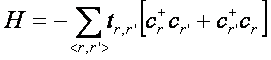
As an illustrative example, let us consider interacting atoms described by a long-ranged tight-binding model,

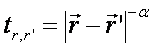
Here the overlap integral is determined by the distance between the atoms and by the nature of the atomic orbitals. The dependence on inter-atomic spacing can be parameterized as a power-law,

where α = 1.5 - 3.0. By breaking the translational symmetry of this system, desired responses can be emulated, e.g. a flat spectral function, or quasi-2D or quasi-3D response in a 1D array.

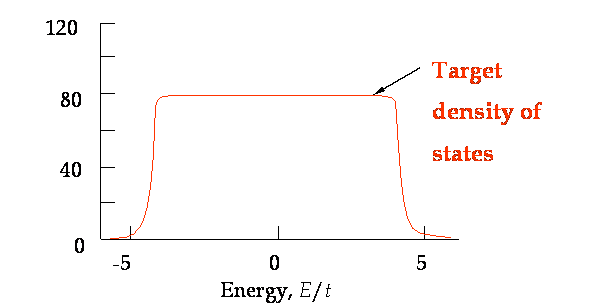
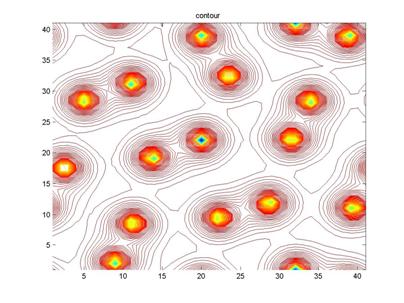
The above left figure shows the resulting spatial configuration of atoms in a two-dimensional system with periodic boundary conditions. The chosen target function in this case is a top-hat density of states that is flat within a certain energy regime, and zero otherwise (shown in the right figure). Since this specific target is particle-hole symmetric, i.e. there are as many states above and below zero-energy, the dominant building blocks that are discovered by the numerical search of the best system configuration are dimer molecules. Other target functions that break particle-hole symmetry require more complicated building blocks, such as trimer and quadrumer molecules.

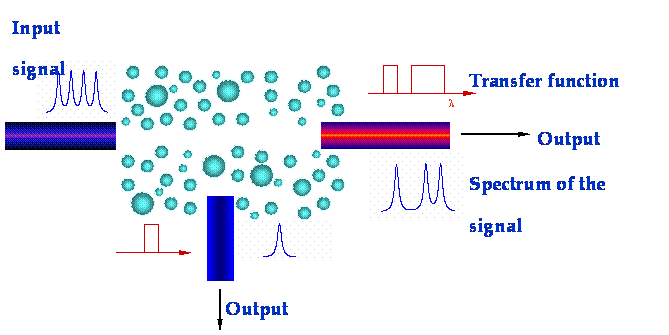
Another example for adaptive quantum design are photonic structures with dielectric rods of variable size and position. Existing devices based on ordered photonic crystals have only limited functionality. On the other hand, adaptive design tools enable new optimized broken-symmetry nano-photonic devices with greater sensitivity, such as mux, combiners, splitters, and channel dropping filters.

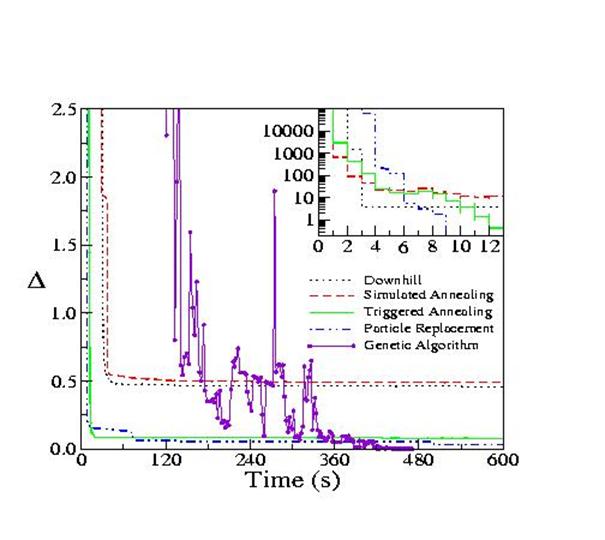
Effective numerical search algorithms are essential to find such configurations in the large phase space of possible solutions which includes collective many-body resonances. We have explored and tested several approaches, including guided random walk, simulated annealing, and genetic algorithms. Their convergence properties differ and depend strongly on system parameters. The plot below shows a comparison of these methods which were benchmarked on the same computer. The convergence criterion Δ in this case is the squared difference between a top-hat target density of states and the density of states achieved by adjusting the positions of the constituent atoms. Its is observed that some of the simpler search algorithms tend to get stuck in local minima, whereas the more sophisticated ones find a lower minimum.

Adaptive quantum design is an enabling method for future advances in nano-technology. It relies on realistic physical models and on efficient numerical search algorithms for global minima. It can be applied to microscopic systems in order to enable and enhance their functionality. The challenge is to solve the inverse problem where a target solution is given and the corresponding system configuration has to be found. On the way to matching such target, new building blocks of broken-symmetry configurations can be discovered. This approach enables us to design ultra-small devices and simultaneously to discover novel phenomena that are not found in conventional solids.

4-14-08


Andie Byrnes

Andie Byrnes is from Great Britain and is doing graduate work at UCL, London working towards her Ph. D. whose thesis is "Origins and development of Neolithic farming in the Faiyum and Cairo areas of Egypt."

As she has written:

"I trained as an archaeologist in Scotland many years ago, but lack of funds and lack of sun drove me into telecommunications (wireless, interactive TV and Internet) where I have been working for the last 15 years. However, once archaeology is in your blood, it never goes away, and I am now carrying out post-graduate studies in Egyptian Archaeology (prehistory) at UCL, London."

Visit her Egyptology sites: