Showing posts with label Copernicus. Show all posts

Monday, December 12, 2011

An issue between Tycho Brahe and Copernicus


Tycho Brahe, the most prominent and accomplished astronomer of his era, made measurements of the apparent sizes of the Sun, Moon, stars, and planets. From these he showed that within a geocentric cosmos these bodies were of comparable sizes, with the Sun being the largest body and the Moon the smallest. He further showed that within a heliocentric cosmos, the stars had to be absurdly large — with the smallest star dwarfing even the Sun. (The results of Tycho’s calculations are illustrated in this paper.) Various Copernicans responded to this issue of observation and geometry by appealing to the power of God: They argued that giant stars were not absurd because even such giant objects were nothing compared to an infinite God, and that in fact the Copernican stars pointed out the power of God to humankind. Tycho rejected this argument.

"REGARDING HOW TYCHO BRAHE NOTED THE ABSURDITY OF THE COPERNICAN THEORY REGARDING THE BIGNESS OF STARS, WHILE THE COPERNICANS APPEALED TO GOD TO ANSWER THAT ABSURDITY" by Christopher M. Graney Jefferson Community & Technical

Friday, July 17, 2009

Element 112..."copernicium"?


Not a "done deal" yet...merely a suggestion.

"Copernicus nominated for the select club of elemental scientists"

The discoverers of element 112, the newest addition to the periodic table, want it named after the 15th century astronomer who had the audacity to suggest the Earth orbits the sun

by

Jacob Aron

July 17th, 2009

guardian.co.uk

The periodic table gained a new element last month. It's currently known as ununbium or simply element 112, but now the scientists who discovered it have proposed a name: copernicium. Sigurd Hofmann and his team at the Center for Heavy Ion Research (GSI) in Germany chose the name to honour 15th century scientist and astronomer Nicolaus Copernicus.

As the first man to realise that the Earth orbits the sun, Copernicus was vilified by the Catholic Church for removing mankind from the centre of creation. His discovery changed the way we looked at the stars and led to the realisation that the universe is a very, very big place. Star-gazers currently celebrating the International Year of Astronomy will agree that copernicium is a fitting legacy.

Don't update your chemistry posters just yet, though. The International Union of Pure and Applied Chemistry won't approve the new name for another six months to allow the scientific community time to discuss any objections to copernicium.

Some Guardian readers may be less than enthusiastic about the new name. When we appealed for suggestions last month, among the 148 comments on the blogpost not a single one of you mentioned Copernicus, although a few other scientist-honouring names were suggested, including my personal favourite, darwinum.

Elements named after scientists are common, as might be expected. If approved, copernicium will join bohrium (element 107) and meitnerium (element 109), for example, which were also discovered by scientists at the GSI and honour the physicists Niels Bohr and Lise Meitner. Albert Einstein, Alfred Nobel and Enrico Fermi can likewise boast elements of their own, namely einsteinium (99), nobelium (102) and fermium (100).

If copernicium doesn't do it for you, though, don't despair. Ununtrium, ununquadium, ununpentium, ununhexium, ununseptium and ununoctium all have (un)unofficial places in the periodic table, and once confirmed will offer plenty of scope for would-be elemental taxonomists.


Copernicus Center For Interdisciplinary Studies

Heliocentric cosmology...Nicolaus Copernicus' birthday

Periodic Table...#112 is official

Rare book...Copernicus...to be auctioned

Wellesely College buys Copernicus book

Tuesday, June 10, 2008

Rare book...Copernicus...to be auctioned


On the Revolutions of the Celestial Spheres
by
Nicolaus Copernicus
1543

Nicolaus Copernicus's book "De Revolutionibus Orbium Coelestium" ("On the Revolutions of the Celestial Spheres"). In it, the Polish astronomer laid out his theory that the Earth and other planets go around the Sun, contravening a millennium of church dogma that the Earth was the center of the universe.

The above and other science related items will be auctioned at Christie's auction house the week of June 16th. So, if you have a few bucks left over from purchasing gasoline and food you might wish to participate.

"Among Scientific Treasures, a Gem"

by

Dennis Overbye

June 10th, 2008

The New York Times

One thing you can say about the copy of Nicolaus Copernicus’s book De Revolutionibus Orbium Coelestium (On the Revolutions of the Celestial Spheres), on sale next week at Christie's auction house, is that it looks and feels old.

Its cover is dented and stained. The pages are warped. You could easily imagine that this book had sat out half a dozen revolutions hidden in various dank basements in Europe.

In fact this book, published in 1543, was the revolution. It was here that the Polish astronomer laid out his theory that the Earth and other planets go around the Sun, contravening a millennium of church dogma that the Earth was the center of the universe and launching a frenzy of free thought and scientific inquiry.

The party, known as the Enlightenment, is still going strong. It was a thrill to hold Copernicus in my hands on a recent visit to the back rooms of Christie's and flip through its hallowed pages as if it were my personal invitation to the Enlightenment. No serious library should be without one. Just in case you are missing your own copy, you can pick up this one for about the price of a Manhattan apartment next Tuesday, according to the Christie's catalog, which estimates its value at $900,000 to $1.2 million.

The Copernicus is a cornerstone in the collection of a retired physician and amateur astronomer, Richard Green of Long Island, that constitutes pretty much a history of science and Western thought. Among the others in Dr. Green's library are works by Galileo, who was tried for heresy in 1633 and sentenced to house arrest for his admiration of Copernicus and for portraying the pope as a fool, as well as by Darwin, Descartes, Newton, Freud, Kepler, Tycho Brahe, Malthus and even Karl Marx.

One lot includes Albert Einstein's collection of reprints of his scientific papers, including his first one on relativity. Another is a staggeringly beautiful star atlas, Harmonia Macrocosmica, by the 17th-century Dutch-German cartographer Andreas Cellarius, with double-truck hand-colored plates.

Pawing through these jaw droppers, I found my attention being drawn again and again to a small white book, barely more than a pamphlet, a time machine that took me back to a more recent revolution. It was the directory for world’s first commercial phone system, Volume 1, No. 1, published in New Haven by the Connecticut District Telephone Company in November 1878, future issues to be published "from time to time, as the nature of the service requires."

Two things struck me. As an aging veteran of the current rewiring of the human condition, I wondered whether there might be lessons from that first great rewiring of our collective nervous system.

Another was a shock of recognition — that people were already talking on the phone a year before Einstein was born. In fact, just two years later Einstein's father went into the nascent business himself. Einstein grew up among the rudiments of phones and other electrical devices like magnets and coils, from which he drew part of the inspiration for relativity. It would not be until 1897, after people had already made fortunes exploiting electricity, that the English scientist J. J. Thomson discovered what it actually was: the flow of tiny negatively charged corpuscles of matter called electrons.

The New Haven switchboard opened in January 1878, only two years after Alexander Graham Bell, in nearby Boston, spoke the immortal words "Mr. Watson, come here. I want you." It was the first commercial system that allowed many customers to connect with one another, for $22 a year, payable in advance.

The first directory consisted of a single sheet listing the names of 50 subscribers, according to lore. By November, the network had grown to 391 subscribers, identified by name and address — phone numbers did not yet exist. And the phone book, although skimpy, had already taken the form in which it would become the fat doorstop of today, with advertisements and listings of businesses in the back — 22 physicians and 22 carriage manufacturers, among others.

Customers were limited to three minutes a call and no more than two calls an hour without permission from the central office.

Besides rules, the embryonic phone book also featured pages of tips on placing calls — pick up the receiver and tell the operator whom you want — and how to talk on this gadget. Having a real conversation, for example, required rapidly transferring the telephone between mouth and ear.

"When you are not speaking, you should be listening," it says at one point.

You should begin by saying, "Hulloa," and when done talking, the book says, you should say, "That is all."

The other person should respond, "O.K."

Because anybody could be on the line at any time, customers should not pick up the telephone unless they want to make a call, and they should be careful about what others might hear.

"Any person using profane or otherwise improper language should be reported at this office immediately," the company said.

If only they could hear us now. On second thought, maybe it's better they can't. Today we are all on a party line, and your most virulent thoughts are just a forward button away from being broadcast to the universe. Would it have killed the founders of the Internet to give us a little warning here?

Near the back of the book is an essay on another promising new wonder that "has attracted renewed attention both in this country and in Europe."

Many of the streets and shops of Paris, it is reported, are now illuminated by electric lights, placed on posts. "People seated before the cafes read their papers by the aid of lights on the opposite side of the way, and yet the most delicate complexions and softest tints in fabrics do not suffer in the white glare of the lamps. Every stone in the road is plainly visible, and the horses move swiftly along as if confident of their footing," the book says.

It makes you wonder what could come next. Oh yes, those horses. No revolution is ever done.

That is all.

On the Revolutions of the Celestial Spheres

More:

"Going once...a first edition of Copernicus's magnum opus"

by

Jon Cartwright

June 13th, 2008

physicsworld.com

Most of you will never have raised an arm at Christie's auction house. But, if you're partial to the odd extravagance, there's a first edition of Nicolaus Copernicus's De Revolutionibus Orbium Coelestium ("On the Revolutions of Celestial Spheres") up for grabs. It'll probably cost you around a million dollars.

Bidding for the 1543 volume starts on 17 June, and I expect it will end up in the vault of some blasé collector. No-one will ever read it, but then it is in Latin, and who understands that these days? Nil desperandum, though, that's what I like to say.

Still, I know of least one physicist who would love to get his hands on it. Owen Gingerich, a historian of astronomy from Harvard University, has spent years tracing copies of Copernicus's masterpiece, partly as an exercise for a book he wrote in 2004. A first edition would be the darling possession on his mantelpiece. "There aren't that many copies in private hands these days," he lamented on the phone to me a few moments ago.

Nowadays Gingerich finds solace in a second-edition. Although considerably less valuable, it does have annotations by Rheticus, the young mathematician who persuaded Copernicus to publish his radical ideas. Gingerich did get the opportunity a few years ago to buy a bona-fide first edition for $50,000, which would have been a good investment but which unfortunately would have required him to re-mortgage his house.

Will Gingerich put in a bid at Christie's this time round? "I figure that even if I had it I'd have to rent a bank safety deposit box to keep it in," he says. "So I'll give it a pass."

Tuesday, May 20, 2008

Greek astronomy texts

From Saint Anselm College a look at some of the original documents on Greek astronomy.

Greek Astronomy

One of the most powerful creations of Greek science was the mathematical astronomy created by Hipparchus in the second century B.C. and given final form by Ptolemy in the second century A.D. Ptolemy's work was known in the Middle Ages through imperfect Latin versions. In fifteenth-century Italy, however, it was brought back to life. George Trebizond, a Cretan emigre in the curia, produced a new translation and commentary. These proved imperfect and aroused much heated criticism. But a German astronomer, Johannes Regiomontanus, a protege of the brilliant Greek churchman Cardinal Bessarion, came to Italy with his patron, learned Greek, and produced a full-scale "Epitome" of Ptolemy's work from which most astronomers learned their art for the next century and more. Copernicus was only one of the celebrities of the Scientific Revolution whose work rested in large part on the study of ancient science carried out in fifteenth-century Italy.

  • Byzantine Astronomical Collection

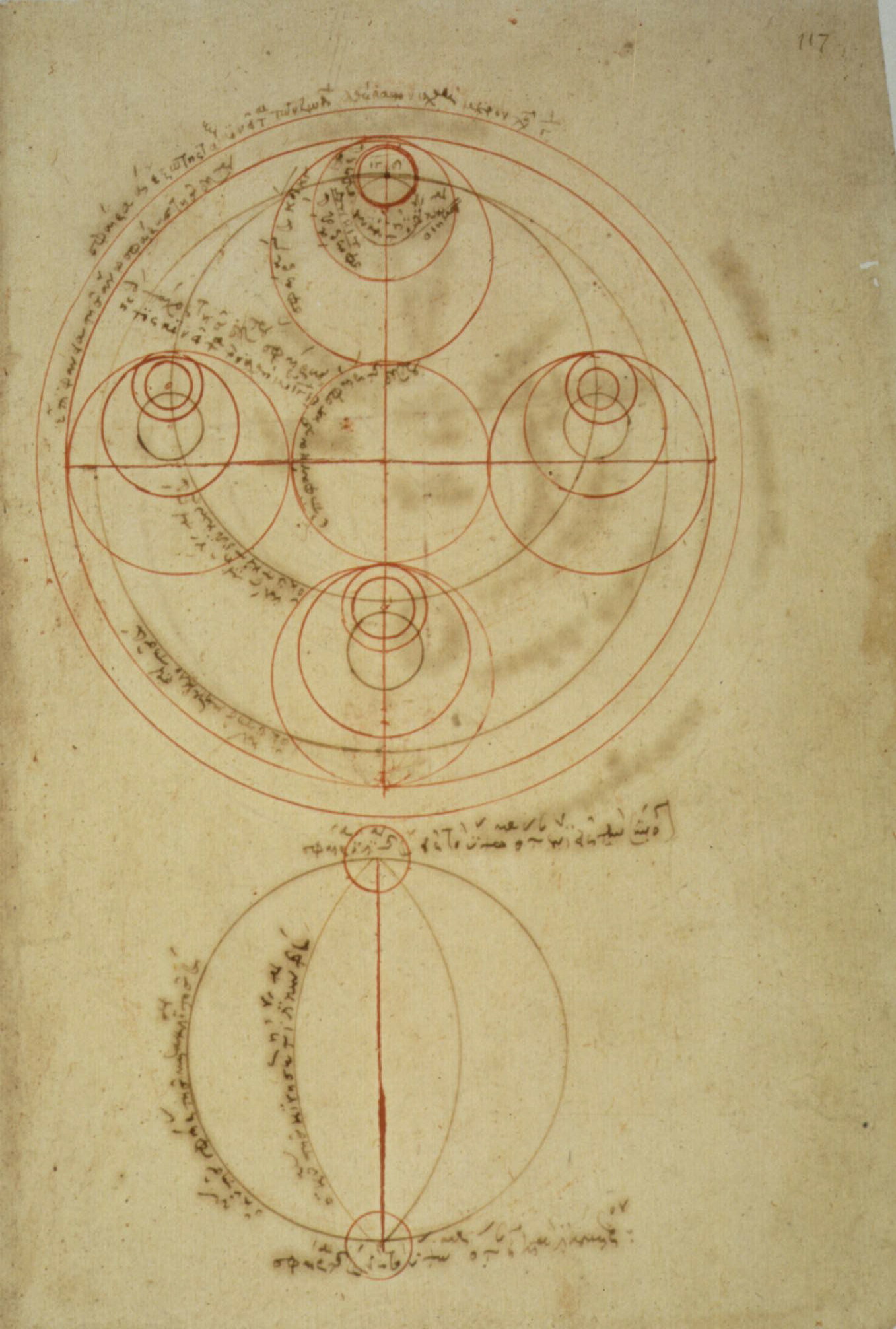
    In Greek, Before 1308

    In the thirteenth and fourteenth centuries, a number of recent Arabic and Persian astronomical works were translated into Greek by scholars who traveled to Persia under the Ilkhanid Empire. One short and confused treatise, translated by Gregory Chioniades, describes Tusi's lunar theory, illustrated, not altogether correctly, in this figure along with Tusi's device for producing rectilinear from circular motions. A part of the planetary and lunar theory of the astronomers of Maragha was later utilized by Copernicus, though scholars do not know how he gained access to this material.

  • Ptolemy, Almagest

    In Latin, Translated by George Trebizond, ca. 1481

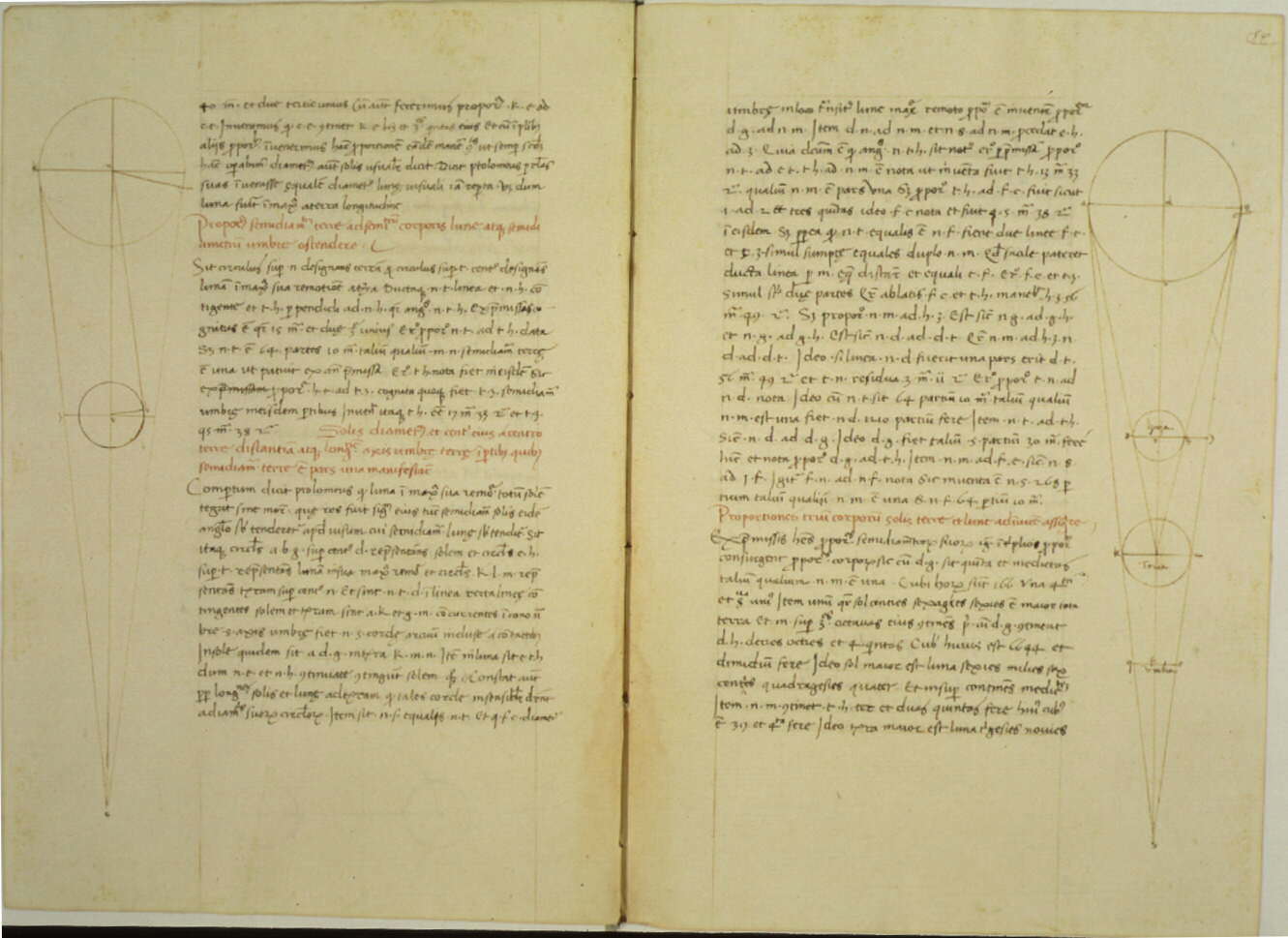
    George Trebizond, one of the notable Greek scholars who came to Italy in the early fifteenth century, made a new translation of the "Almagest" from the Greek for Pope Nicholas V between March and December of 1451. Due to a dispute about the quality of Trebizond's commentary on the text, the translation was never dedicated to Nicholas. This very elaborate manuscript of the translation, with the figures drawn in several colors, was dedicated to Pope Sixtus IV by George's son Andreas. These pages show Book VI Chapter 7, on the computation of the duration of solar and lunar eclipses.

  • George Trebizond, Commentary on the Almagest

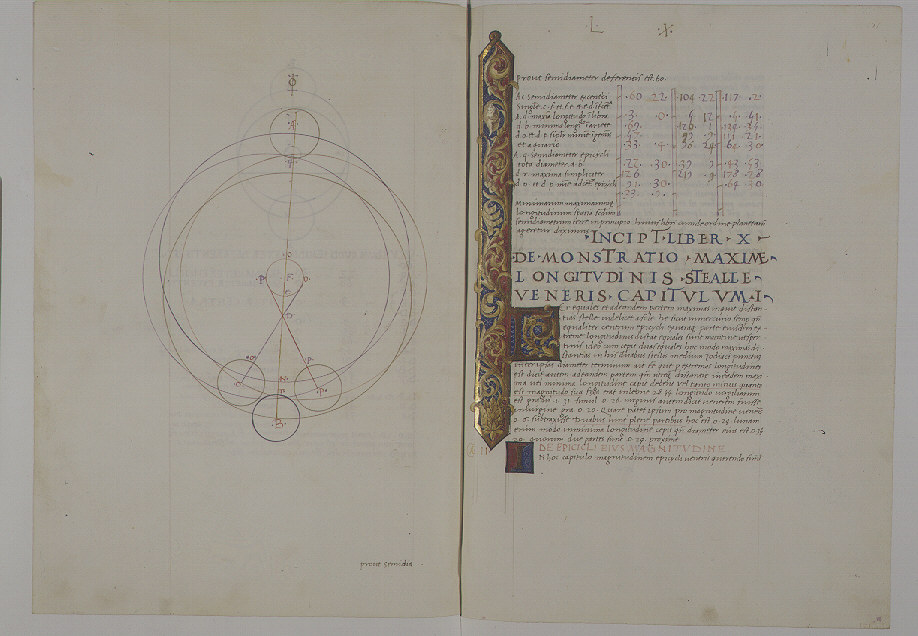
    In Latin, ca. 1482

    During the same nine months that George Trebizond made his translation of the "Almagest," he also wrote a commentary as long as the original text. The commentary was severely criticized, however, which resulted in a falling out with Pope Nicholas V. This opulent manuscript was dedicated to Pope Sixtus IV by George's son Andreas along with Vat. lat. 2055 of the translation. These pages contain a large figure of the model for the planet Mercury, shown at its least distance from the earth, with a list of Mercury's parameters and distances, and then the beginning of the treatment of Venus in Book X.

  • Nasir ad-Din at-Tusi, Tadhkira

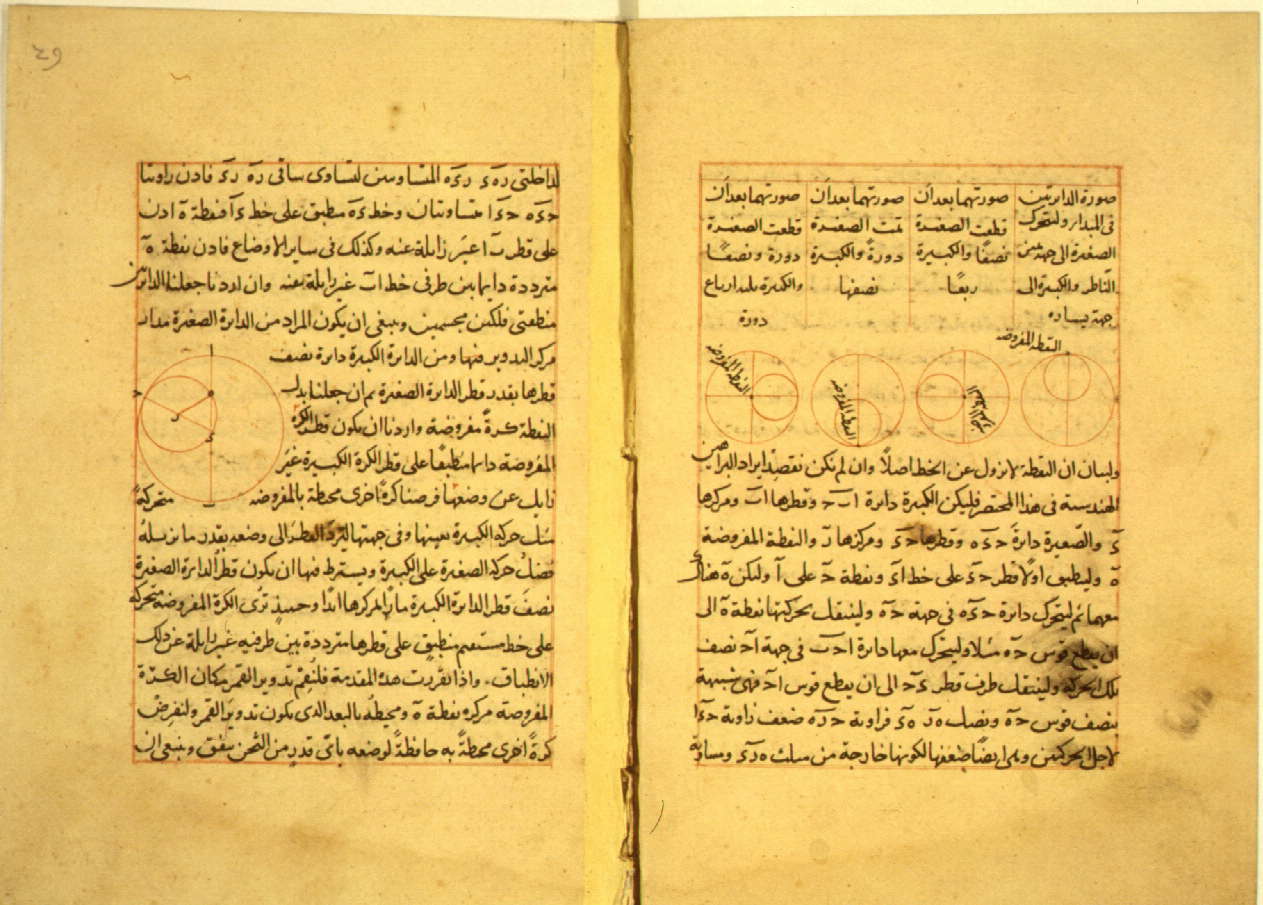
    In Arabic, Fourteenth century

    Nasir ad-Din at-Tusi was among the first of several Arabic astronomers of the late thirteenth century at the observatory of Maragha in Persia who modified Ptolemy's models based on mechanical principles, in order to preserve the uniform rotation of spheres. This early Arabic manuscript contains his principal work on the subject, the "Tadhkira fi ilm al-Haya" (Memoir on Astronomy). The figure shown here is his ingenious device for generating rectilinear motion along the diameter of the outer circle from two circular motions.

  • Georg Peurbach and Johannes Regiomontanus, Epitome of the Almagest

    In Latin, Late fifteenth century

    The "Epitome of the Almagest" was written between 1460 and 1463 by Georg Peurbach and Johannes Regiomontanus at the suggestion of Cardinal Bessarion. It gave Europeans the first sophisticated understanding of Ptolemy's astronomy, and was studied by every competent astronomer of the sixteenth century. The illustration here shows the distance of the sun from the earth as 1210 terrestrial radii (about 4,800,000 miles), which is too small by a factor of twenty, but gives a solar parallax (the maximum displacement due to observing the sun from the surface rather than from the center of the earth) of less than 3 minutes, still well below the limit of observational accuracy.

  • Ptolemy, Geography

    In Greek, Fifteenth century

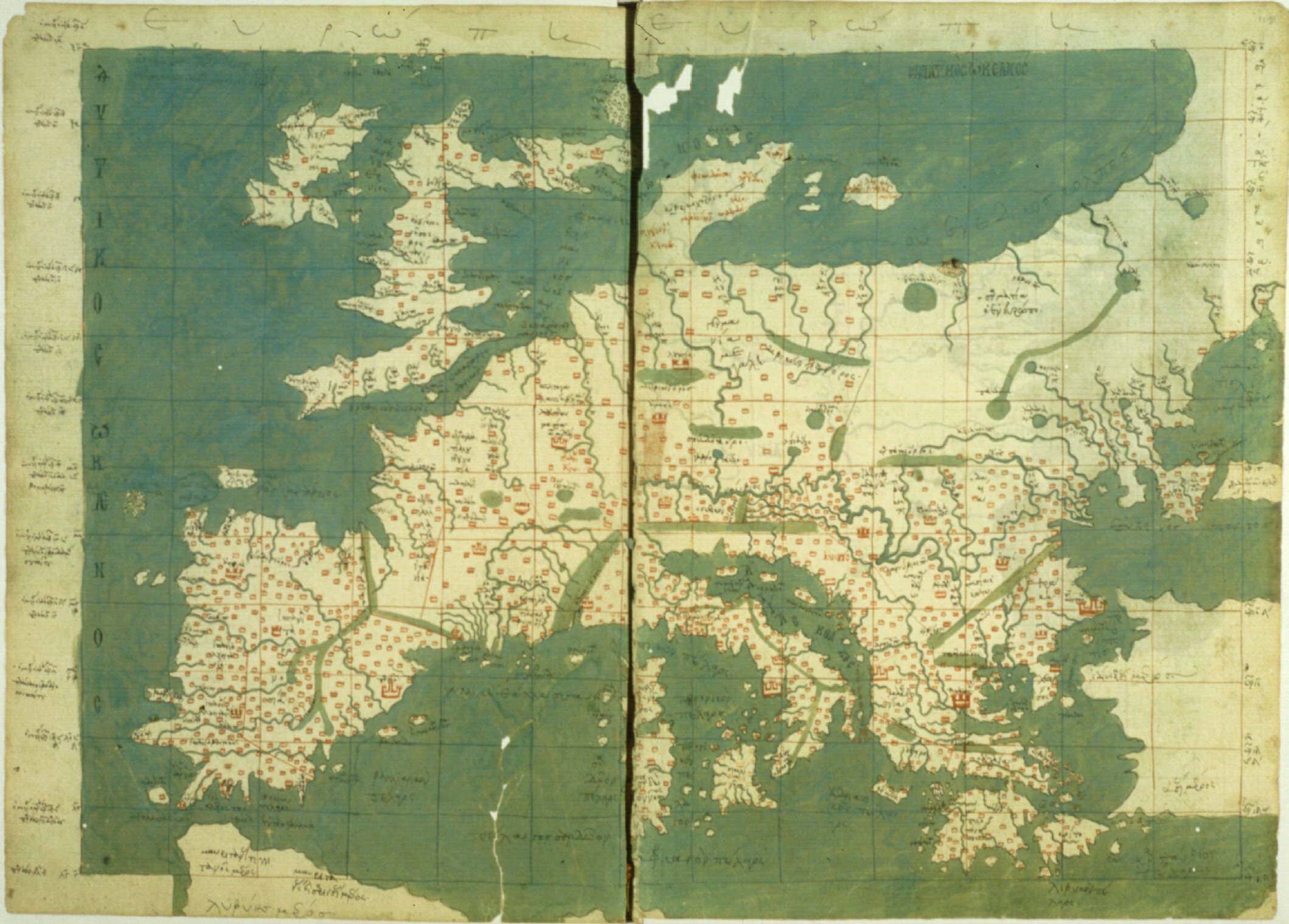
    Ptolemy's "Geography" contains instructions for drawing maps of the entire "oikoumene" (inhabited world) and particular regions, along with the longitudes and latitudes of about eight thousand locations in Europe, Africa, and Asia. The maps in manuscripts of the "Geography," however, date only from about 1300, after the text was rediscovered by Maximus Planudes. There are two versions, the A recension with twenty-six large regional maps, and the B recension, displayed here, with sixty-four smaller regional maps and four large additional maps. Shown here is the additional map of Europe which reveals Ptolemy's systematic exaggeration of west to east distances, particularly in the eastward extension of Scotland and the west to east slope of Italy.